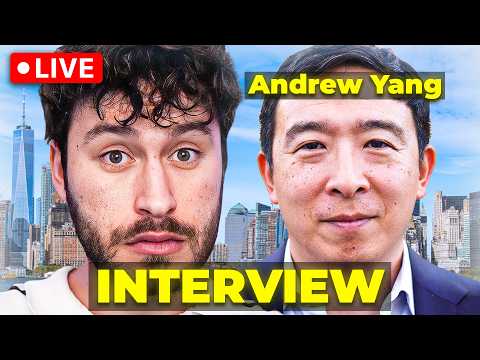
Michael articulates that the traditional American dream, characterized by education, stable jobs, and homeownership, is broken for the current generation. He explains that his community consists of 'hustlers' trying to succeed outside the established system because they feel it's the only viable path for survival in the current economic climate.
Andrew Yang: The Power of Leadership and Mentorship
Andrew Yang offers a counter-narrative to pure pessimism by advocating for personal development through leadership and mentorship, inspired by the West Point model. He suggests that young people should seek mentors and take responsibility for leading something, however small, to gain experience and learn from both successes and failures. He emphasizes that quitting strategically is also an underrated skill.
Andrew Yang: The Two Sides of the K-Shape
Andrew Yang outlines two key approaches to the 'K-shaped' economic reality: first, how to fix it politically and structurally, and second, how individuals, especially young people, can get into the opportunity side of the K. He emphasizes the importance of addressing both systemic issues and individual strategies for success.
Yang's Entrepreneurial Hustle: Nightclub Promotion
Andrew Yang recounts his early entrepreneurial ventures, specifically as a nightclub promoter, highlighting how it was possible to succeed with zero capital. He explains that the key was leveraging social capital and an email list, not money. Yang details the typical deal struck with venues: a percentage of bar sales above a guarantee, plus free drinks and a table. This allowed him and his partners to host events, provide value to venues by bringing in customers, and potentially earn significant income. He emphasizes that this experience taught him valuable lessons in entrepreneurship, demonstrating that a successful hustle can be built on non-monetary capital.
The Declining American Dream: Economic Mobility Wanes
Andrew Yang presents data indicating a significant decline in economic mobility, stating that individuals born in the 1960s had a 93% chance of doing better than their parents, a figure that has dropped to around 39% for those born later. He argues that while the overall economy might be growing, the gains are not being distributed broadly, leading to increased difficulty in 'making it.' Yang suggests that this trend will likely continue, especially with the advent of AI, making the path to upward mobility narrower. He advises individuals to approach their goals with the mindset of succeeding despite these challenges, rather than succumbing to the pressure of a finite timeline.
AI's Economic Disruption: The Catrini Thesis
Andrew Yang discusses the '2008 Global Intelligence Crisis' thesis by Satrini, which posits that AI will be more advanced than advertised, leading to mass layoffs, the commoditization of software, and a deflationary recession. Yang finds the article's energy and clarity compelling, comparing AI's impact on knowledge workers to automation's impact on factory workers in the 80s and 90s. He agrees that entire companies could become obsolete and that the timeline, while perhaps debated, points towards significant disruption. The core argument is that AI represents a fundamental shift that will displace many jobs and reshape the economy, potentially mirroring past industrial revolutions but at an accelerated pace.
The 'Lite' Concept: Resistance to AI Infrastructure
Yang discusses the 'lite' concept, referencing protests against data centers and the halting of large-scale AI infrastructure projects. He notes that companies like Block are laying off employees, citing AI, while simultaneously, massive data center build-outs are paused due to protests. He humorously suggests that protesting data centers might become a lucrative job. Yang and the host explore whether this resistance could evolve into a class war, with Yang predicting flashes of anger and reprisal against AI targets like robotaxis, but doubting it will become a full-fledged movement unless the protesters become too organized, drawing a parallel to the historical suppression of organized groups.
Based 16Z: Late-Stage Capitalism's 'Steal and Run' Playbook
The discussion introduces the concept from an article titled 'Loot and Rob,' suggesting that America is in a late-stage capitalist phase where elites prioritize extracting maximum value as quickly as possible before the system collapses. Examples include companies staying private longer to extract venture capital, SpaceX's high valuation benefiting early investors while retail investors are 'rinsed,' and instances of perceived 'grift extraction' events. This mirrors a 'Soviet oligarch playbook,' where the incentive is to 'steal, take, and run' rather than play by established rules. The interviewer questions if this trend is truly happening and how Yang perceives it.
The 'Tripod' of Value: Commercial, Philanthropic, Political
Andrew Yang introduces a 'tripod' framework for understanding value creation and contribution: commercial, philanthropic, and political. He notes that while commercial success is often the primary focus, philanthropic and political endeavors also hold significant value. Yang shares his personal experience of rotating among these three 'legs,' often engaging in all simultaneously. He emphasizes that individuals, especially younger ones, should recognize the diverse forms of value they bring beyond just financial currency, such as time, energy, attention, and network. This holistic view encourages a broader definition of success and contribution, moving beyond purely market-driven metrics.
Trump's Market References: A New Level of Directness
The interviewer asks if the direct referencing of stock market performance by political leaders is a new phenomenon. Yang confirms that while past administrations might have occasionally mentioned the stock market, Donald Trump has elevated this practice to an unprecedented level. He notes that it was previously considered 'bad form' for leaders to solely point to the stock market as proof of their success. This direct linkage, Yang suggests, is a key differentiator of the Trump era, making the market's performance an overt political talking point.
Geopolitical Tensions and Oil Market Manipulation
The discussion explores the interplay between geopolitical events, specifically the conflict with Iran, and the oil market. Both sides, the US administration and Iran, are accused of manipulating oil prices for political gain. The US aims to keep prices low to avoid economic pain for Trump politically, while Iran seeks higher prices to validate its position. The interviewer notes the difficulty in discerning truth amidst posturing and the potential for AI-generated disinformation. Yang acknowledges this manipulation, stating that Trump is trying to 'buy time' by influencing market sentiment, particularly regarding gas prices, which have direct political implications.
Generational Shift Towards Speculation and Hustle Culture
The conversation touches upon the cultural implications of a generation programmed to speculate and hustle, citing examples like flipping sneakers and using bots for limited-edition drops. Yang relates this to Nate Silver's concept of 'Riverians' – financiers, entrepreneurs, and developers who operate on the 'edge' of the market, seeking inefficiencies. He identifies himself as a 'Riverian who cares about the village,' recognizing that AI will disrupt many, including fellow Riverians. This hustle culture, while potentially lucrative, raises questions about its long-term societal impact and whether it fosters genuine value creation or merely speculative arbitrage.
Yang: Wireless Service is a Consumer Rip-off
Andrew Yang argues that U.S. wireless carriers like Verizon and AT&T are engaging in significant consumer gouging, charging Americans substantially more than Europeans for similar services. He points to the billions paid out in shareholder dividends as evidence of where the money is going, rather than service improvement. This practice, he suggests, is largely unnoticed by the public despite the constant bombardment of wireless ads.
Michael: California's Economic Decline and Hollywood's Future
Michael expresses sadness over California's economic decline, citing significant job losses in Los Angeles and Hollywood. He argues that to revitalize Hollywood, the state must offer competitive tax breaks, similar to those in Vancouver, London, or Atlanta, to attract and retain film production. The decrease in shoot days impacts not just actors but also numerous support industries, highlighting the interconnectedness of the entertainment economy.
Yang on Campaign Makeovers and Appearance
Andrew Yang confirms that many political candidates invest in their appearance, citing examples like Chris Christie's weight loss surgery. He notes that campaign managers often push for makeovers, and candidates can visibly 'gear up' for a campaign through positive physical changes. He shares a personal anecdote about being told to wear a suit instead of a polo for an interview, acknowledging the importance of presentation in public life.
Yang's Advice: Focus on Personal Growth Amidst Chaos
Andrew Yang advises young people facing external 'noise' like economic downturns and political instability to focus intensely on their own immediate goals, surroundings, and opportunities. He shares his own journey of starting a failed company, joining another, and eventually leading a tutoring business, emphasizing a 'grind' mentality. He stresses the importance of tuning out the noise, writing down goals, and building success brick by brick, drawing from his own experience of prioritizing personal development over macro-level anxieties.
Market Close: A Rough Day
The market experienced a rough close, with major indices like the SPY, Russell, and Qs down around 1%, despite opening green. Crypto markets were particularly awful, while the Dow managed a slight gain. This performance suggests a broader market downturn is underway, reinforcing the idea that reaching the top 20% is a crucial goal for survival.
Oil Prices Surge Amidst Geopolitical Uncertainty
Oil prices are significantly up, with Brent crude holding above $100 per barrel. This surge is occurring despite geopolitical events that might typically cause a downturn, suggesting that the market is reacting in unexpected ways. The speaker notes that 'tacos' (positive news) are no longer effective market drivers, and even aggressive rhetoric from figures like Trump is having a muted impact.
The Evolving Nature of Warfare: Order Books Over Bullets
The speaker posits that modern warfare is increasingly fought in 'order books' rather than through traditional kinetic aggression. This shift means that financial markets and digital infrastructure are becoming primary battlegrounds, with events like the Iran situation having a profound impact on trading and economic stability. The speaker references a clip suggesting that the 'monopoly on violence' is gone, and 21st-century wars are fought in the digital realm.
Trump's Unhinged Iran Threat
Donald Trump issued a highly aggressive social media post threatening to destroy Iran's energy and desalination plants if a deal was not reached and the Hormuz Strait was not opened. The speaker describes this as an 'unhinged' and 'keyboard warrior' tactic, noting that such threats, while severe, are having a diminishing impact on markets, suggesting a desensitization to extreme rhetoric.
Market Uncertainty and Trading Strategies
The current market environment is characterized by extreme uncertainty, with many participants holding cash or engaging in short-term trades. The speaker notes that significant moves like a 10% drop on SPY haven't occurred recently, making it difficult to establish long-term positions. The advice is to be cautious, as most people's net worth is down, and having cash or income provides a superior position.
Crypto's Stagnation: A Different Kind of Fear
While Bitcoin and other cryptocurrencies have seen significant downside, the real fear for crypto investors is not the dump, but the prolonged period of stagnation and lack of movement. This 'nothingness' can be more damaging than volatility, as it tests investors' patience and commitment over extended periods, making it difficult to justify holding positions.
Host: Iran's Declining Interception Rate
The host presents data suggesting Israel's missile interception rate against Iranian attacks has significantly declined, from 95% to 54%. This is attributed to Iran's strategy of firing fewer missiles to conserve stockpiles and deplete Western interceptors, indicating a potential shift in the conflict's dynamics. The host notes the difficulty in verifying these claims amidst information warfare. This suggests a strategic advantage is shifting, though concrete proof remains elusive.
Host: Market Manipulation and Uncertainty
The host expresses deep skepticism about the authenticity of market movements, particularly in oil and crypto, suggesting they are manipulated. He laments being 'long the wrong oil' and likens the commodity market's volatility to 'Memecoin Monday.' This uncertainty leads him to question the reliability of market indicators, stating, 'there's no way to actually know what's happening.' The conclusion is that the entire system is suspect. This highlights a pervasive distrust in financial markets.
Host: The Dire Economic Impact of Prolonged Lockdowns
The host argues that continuing current operating procedures without a vaccine will lead to a 'depression era period' and millions of deaths globally. He uses Hilton Hotels as a 'canary in the coal mine,' stating its stock is plummeting and will 'go to zero' along with all other hotel companies due to an inability to survive 18 months without revenue. This paints a grim picture of economic collapse if drastic measures aren't taken. This highlights the severe economic consequences of extended public health measures.
Host: Michael Saylor's Bitcoin Strategy as Ponzi
The host harshly criticizes Michael Saylor's strategy of taking out loans against Bitcoin holdings to pay taxes, calling it 'financial alchemy' and predicting it will be studied as a 'Ponzi' scheme. He questions how Saylor will refinance debt if Bitcoin plummets, suggesting that banks would not lend against such volatile collateral. The host's visceral reaction ('my skin like is crawling') highlights his deep skepticism and belief that Saylor's approach is unsustainable and reckless. This frames Saylor's actions as a dangerous gamble.
Host: Andrew Yang's Validation of the 'Pit'
The host praises Andrew Yang, stating Yang validates the existence of 'the pit' – presumably a community or platform for financial learning and opportunity. Yang's message that one 'got to get it how you can get it' and won't exclusively get it from a corporate job resonates with the host. He believes Yang's perspective supports the idea that the community can achieve success, even if it requires immense effort and dedication. This suggests Yang's philosophy aligns with the host's own entrepreneurial and market-focused ethos.