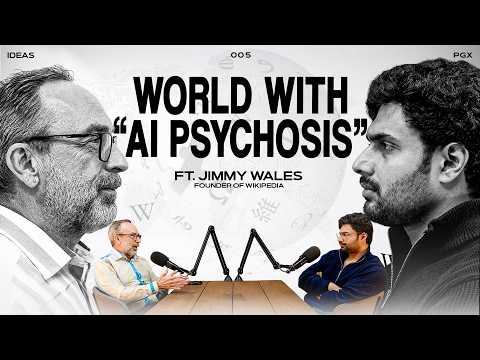
Wikipedia Founder Jimmy Wales on LLM Psychosis, Death of Real Knowledge & the Post-Truth Internet
Prakhar Gupta: The Internet's Compression of Mystery
The internet's vast scaling of information and media has compressed our understanding of the world, diminishing the sense of mystery and novelty. Unlike previous eras where distant places or concepts held an aura of the unknown, today's instant access to information, images, and videos can lead to a form of 'existential boredom.' This accessibility, while convenient, might reduce the profound impact of experiencing the world firsthand.
Jimmy Wales: AI as a Break and Continuation
Artificial intelligence, particularly large language models, represents both a break from and a continuation of the principles behind Wikipedia. The break lies in the novel conversational interface and AI's surprising creativity, which contrasts with its current factual inaccuracies ('hallucinations'). The continuation is seen in the open-source nature of many AI developments and the community-driven exploration of its potential, echoing Wikipedia's collaborative ethos.
Democratizing Intelligence vs. Knowledge
The free internet and Wikipedia democratized knowledge by making information accessible, whereas AI could be seen as an attempt to democratize intelligence by providing expert-level assistance to anyone. This accessibility, however, raises questions about how effectively people are using these tools and whether they are truly learning.
The Value of Effort in Learning
Jimmy Wales argues against the notion that easy access to information diminishes learning, stating that the 'hard yards' of understanding are essential and that barriers like manual library searches were often inefficient. He posits that the value lies in the learning process itself, not just the speed of information retrieval.
Jimmy Wales: Wikipedia's Stance on Neutrality and AI's Bias
Wikipedia's core principle is neutrality, making it unsuitable for personal opinions. In contrast, AI models, like those potentially used by Elon Musk, can exhibit biases, raising concerns about the trustworthiness of AI-generated information. While AI is improving, its tendency to 'hallucinate' or present misinformation remains a significant challenge, making it unreliable for factual accuracy compared to Wikipedia's rigorous editorial process.
AI's Struggle with Neutrality vs. Wikipedia's 'Meta' Approach
AI models, unlike Wikipedia, struggle to maintain neutrality due to business models and owner biases. Wikipedia's strength lies in its 'meta' approach, describing controversies and presenting different viewpoints without taking a side, which is a complex but achievable goal for handling contentious topics like abortion.
Prakhar Gupta: The Peril of Echo Chambers
The nature of media platforms, whether podcasts or Twitter, often dictates the format of conversation, leading to entrenched sides and a lack of nuanced understanding. This environment makes it difficult to engage with honest individuals seeking genuine knowledge, as bots and paid operatives flood the discourse.
Jimmy Wales: AI's Impact on Knowledge Absorption
While basic questions might be adequately answered by quick searches, important decisions—like health or political choices—require deeper engagement than simply accepting the first AI-generated answer. The internet has increased access to knowledge, but the depth of absorption depends on the user's motivation and the criticality of the decision.
AI's Impact on Software Development
AI won't end software development but will transform it, making custom coding cheaper and unleashing demand for specialized websites and applications. The bottleneck will shift from coding to marketing and market fit.
The Hallucination Problem in AI and Wikipedia
Large Language Models are currently terrible for writing Wikipedia articles because they lack a concept of truth and reality, often hallucinating facts and even fabricating references. This makes them dangerous for knowledge platforms that prioritize accuracy.
The Peril of AI-Generated Fake Images
The proliferation of AI-generated images, like the fake photo of Pope Francis in a puffer jacket or the debate around Netanyahu's images, erodes trust in visual media. This makes it increasingly difficult to discern truth, potentially leading to a 'post-truth' era where verifiable facts are scarce.
Prakhar Gupta: The Trust Paradox of Partisan News
When newspapers make political endorsements or publish overtly partisan opinion pieces disguised as news, it doesn't just alienate opposing readers; it can also erode trust among those who agree. Readers may start questioning the objectivity of all news reporting, even when they align with the opinion, leading to a broader skepticism about the media's integrity. This phenomenon suggests that overt bias, even when favorable, can be counterproductive to building and maintaining public trust in journalistic institutions.