Bernoulli Equations Made Easy (Differential Equations 24.5)
Professor Leonard's Simplified Approach: Dividing by the Y-Function
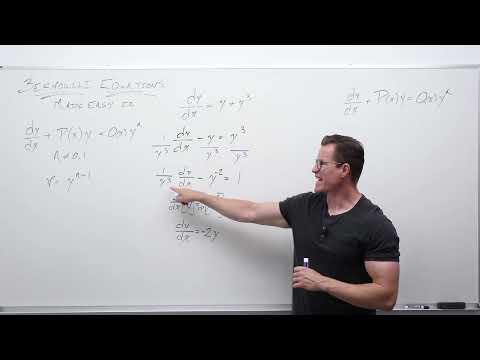
Instead of direct substitution, the speaker proposes dividing the Bernoulli equation by the function of y (specifically, y^n) to simplify the structure. This step, performed before substitution, transforms the equation into a form where a more direct substitution can be made. The goal is to isolate terms and prepare the equation for a substitution that will lead to a linear differential equation. This initial division by y^n is crucial for setting up the subsequent steps.
Transformation into a Linear First-Order Differential Equation
By applying the substitution V = Y^(1-n) and its derivative, the original Bernoulli equation is systematically transformed into a linear first-order differential equation of the form dV/dx + P(x)V = Q(x). This transformation is achieved by replacing the y-terms and the (1/y^n)dy/dx term with expressions involving V and dV/dx. The speaker emphasizes that this linear form is significantly easier to solve than the original Bernoulli equation.
Professor Leonard: Mathematical Proof of General Applicability
The speaker provides a rigorous mathematical proof to demonstrate that the simplified method works for any general Bernoulli differential equation. By starting with the general form dy/dx + P(x)y = Q(x)y^n and applying the substitution V = y^(1-n), the proof shows that the term (1-n)y^(-n)dy/dx always appears, which can be directly related to dV/dx. This confirms that the transformation into a linear equation is not coincidental but a fundamental property of Bernoulli equations when approached this way.
Historical Context: Lin's Contribution to Bernoulli Solutions
The speaker reveals that the simplified method, which they initially thought was their own discovery, was actually proven by Lin in 1696. This historical context adds depth to the explanation, acknowledging the long-standing mathematical foundations of the technique. The speaker humorously admits to feeling 'like an idiot' upon discovering this, highlighting the value of historical mathematical research.
Professor Leonard: Simplifying Bernoulli Equations
Bernoulli equations, typically solved with a specific substitution, can be more easily handled by recognizing them as a form of embedded derivative. This approach transforms the equation into a linear first-order differential equation, which is generally simpler to solve using integrating factors. The speaker emphasizes this method's efficiency over older, more cumbersome techniques.
Professor Leonard: The Embedded Derivative Trick
Bernoulli differential equations can be significantly simplified by recognizing them as a special case of an embedded derivative, allowing for a more straightforward solution process. This technique involves identifying the structure, applying an integrating factor, and performing a substitution to transform the equation into a solvable form. The speaker emphasizes that this method makes handling Bernoulli equations much easier.