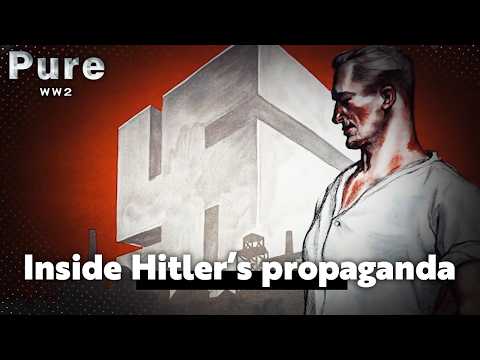
Hitler’s propaganda | Episode 1: How to build a brand ? I Pure WW2
Professor Richard Evans: Exploiting the Treaty of Versailles
The humiliating terms of the Treaty of Versailles, including war guilt and reparations, created deep resentment in Germany. Hitler effectively exploited this national grievance, positioning himself as the one who could restore Germany's honor and strength.
Professor Ian Kershaw: Hitler's Oratorical Style
Hitler possessed a unique oratorical style, characterized by a raspy voice (a result of WWI gas exposure) and a distinctive accent that set him apart. He began speeches quietly, building intensity with dramatic gestures and slogans, effectively captivating audiences with emotion rather than complex arguments.
Professor Richard Evans: The Politics of Grievance and Enemy Creation
The Nazis effectively employed a 'politics of grievance,' amplifying feelings of betrayal and injustice among the German people. They created clear enemies, notably Jews and Bolsheviks, scapegoating them for Germany's problems and aligning with existing anti-Semitic sentiments.
Narrator: Influences from Communism and Fascism
The Nazi party borrowed heavily from communist propaganda methods and was significantly influenced by Mussolini's fascist movement in Italy. They adopted techniques like using red in their imagery to attract workers and emulated the theatricality and spectacle of fascist rallies and symbols, like the Roman salute.
Professor Ian Kershaw: The Beer Hall Putsch and Learning from Failure
The failed Beer Hall Putsch in 1923 taught Hitler a crucial lesson: direct confrontation with the state was futile. He realized that undermining the state had to be achieved through legal means, primarily propaganda, rather than armed revolution.
Professor Richard Evans: 'Mein Kampf' as Blueprint and Manifesto
Hitler's book, 'Mein Kampf,' served as both a personal manifesto rooted in his life experiences and a strategic blueprint for propaganda. It detailed methods like the 'big lie' and the repetition of messages ('hammer blows') to overcome audience resistance and demonize enemies.
Narrator: The Power of Nazi Symbols and Visuals
Symbols like the swastika flag, designed by Hitler himself, were crucial for Nazi propaganda, visually communicating the party's ideology and enemies. The Nazi regime masterfully utilized new mass media, especially photography and film, to saturate the public sphere with powerful, emotionally resonant images.
Narrator: The Nuremberg Rallies and Film Propaganda
The revived Nazi party rallies, particularly at Nuremberg, became elaborate spectacles designed to solidify internal party bonds and project an image of power. Joseph Goebbels, inspired by Soviet cinema, recognized the potential of film to captivate audiences, leading to the production of rally films.
Professor Richard Evans: The Impact of the Great Depression
The 1929 stock market crash and subsequent Great Depression plunged Germany into severe economic crisis, with unemployment soaring. This widespread hardship eroded faith in the existing democratic system, creating fertile ground for extremist parties like the Nazis.
Narrator: Nazi Propaganda and Media Control
By 1930, Nazi propaganda efforts focused not only on disseminating their message but also on preventing access to opposing ideas. They actively disrupted anti-war films like 'All Quiet on the Western Front,' demonstrating their willingness to dictate terms to the government and control the narrative.
Hitler's Modern Persona
The Nazi campaign strategically leveraged Hitler's image as a modern, energetic force, utilizing theatrical elements like flying over Germany to emphasize his difference and appeal to a sense of change. This persona was crucial in differentiating him from the more traditional figure of Hindenburg.
Media Empire and Poster Artistry
Hugenberg's media empire provided extensive exposure through newspapers and newsreels, while Goebbels's poster marketing focused intensely on Hitler's persona as Germany's savior, deliberately avoiding specific policy promises. These posters, often featuring Hitler's face prominently, were designed for maximum psychological impact in a pre-television era.
The Brand Fulfilled: Chancellor Hitler
Upon his swearing-in as Chancellor on January 30, 1933, Hitler had successfully delivered the brand he had meticulously built over a decade. The subsequent SA march and celebrations symbolized the culmination of this 'brand building,' transforming him into both statesman and savior.