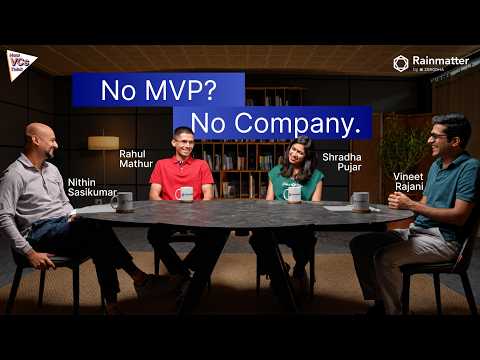
How VCs Evaluate Your MVP | Minimum Viable Product framework ft Rahul & Shradha | How VCs Think Ep 6
Shradha Pujar: MVP in Consumer Hardware & Deep Tech
For consumer hardware like Dreamspan's mattress monitor, the MVP is a tangible prototype that early believers (first 50-100 customers) pay for, providing early scientific proof. In deep tech, indicative Letters of Intent (LOIs) from entities, or assembling a dedicated team working on nights and weekends, serve as crucial signals of viability before full product realization.
Rahul Matur: Validating Ideas Without a Product
Founders can validate ideas by being 'outside-in' (studying past attempts), rigorous in testing hypotheses (customer interviews, learning takeaways), and resourceful (rallying talent/capital). This involves understanding industry history, being receptive to feedback, and demonstrating an ability to overcome resource constraints, even with limited personal capital.
Founder-Market Fit vs. MVP
When a product is nascent or a prototype, VCs bet more on 'founder-market fit'—the founder's vision and ability to rally a team and create demand. This is distinct from an MVP, which focuses on product validation. The ability to sell the dream to employees, investors, and customers is paramount for founders in these early stages.
The Genesis of Peak State IPs
The initial MVP for Peak State involved creating camaraderie through shared activities, which evolved into distinct IPs like Founders Peak, Peak State Festival, and No Parking. These IPs were tested for MVP status, and their collective success culminated in the large-scale Peak State Festival.
Hyrox: A Leap of Faith in India
Hyrox's success in India, despite high costs and initial skepticism about the market, exemplifies a 'leap of faith' rather than a traditional MVP validation. The event's inherent virality, driven by photogenic elements and social media potential, was a key factor in its rapid adoption.
Beim Pay's MVP: User Validation and Skin in the Game
Beim Pay's MVP involved building an interactive wireframe using Glide, testing it with over 55 individuals, and gathering feedback on a shared problem statement. Willingness of users to share PII (insurance documents) provided the confidence to leave a job and pursue the venture, demonstrating 'skin in the game'.
The Evolving MVP: Category Maturity and Fast Followers
The MVP bar is sector-specific and category-maturity dependent. For fast followers in crowded markets like quick commerce, the MVP is a scaled-down version with a unique hook (e.g., Prime subscription for Amazon), not a barebones offering. Net new category creation, however, often looks 'ugly' and unclear initially.
MVP vs. PMF in Logistics: Proving the Financial Model
For tech-enabled, execution-led businesses like Zepto, the MVP is proving a financial model over time, starting with a single dark store. Product-market fit might be achieving capacity, but profitability and a sustainable business model emerge later through avenues like advertising or private labels.
MVP for Protein Brands: Focus and Clinical Backing
An MVP in the protein supplement space requires a narrow focus (e.g., women 25-35 with hormonal acne), a specialist doctor's involvement, and validation from 50-100 users. It should address a specific problem like hormonal acne or PCOS, backed by feedback and potentially an endocrinologist's endorsement.
Healthcare SaaS MVP: Overcoming Inertia
For healthcare SaaS, an MVP involves a hospital testing a new platform for a small vertical (e.g., OPD consultations) and demonstrating staff readiness and doctor workflow acceptance. True PMF is achieved when the hospital fully adopts the new system, migrating data and letting go of legacy solutions.
Healthcare MVPs: Beyond the Code
In healthcare, an MVP isn't just about a functional product; it's heavily reliant on founder-market fit, strong relationships, and the ability to sell long-term deals. A simple functional MVP might not be enough for VCs if it doesn't demonstrate deep understanding and traction within this relationship-driven sector. The intent to try, even without a formal LOI, can be a signal, but significant customer agreements are crucial for validation. This nuanced approach acknowledges the unique complexities of healthcare sales and adoption cycles. The ultimate goal is to build a sustainable business, not just an MVP.
The Evolving MVP Landscape: AI's Impact
The advent of AI and no-code tools has drastically lowered the barrier to building software, making it 100x easier in some aspects. This ease of creation, however, has paradoxically raised the bar for product quality and market differentiation. In consumer tech, ugly or incomplete products are no longer acceptable. In enterprise, the speed of iteration and problem-solving must accelerate dramatically, as numerous competitors will emerge quickly. The focus shifts from mere functionality to taste, judgment, and solving novel problems with unique workflows.
Y Combinator's Timeless MVP Framework
The Y Combinator framework for MVPs remains remarkably relevant: 1. Identify a core hypothesis and solve one painful problem for a specific user. 2. Ruthlessly cut features to the bare minimum needed for testing assumptions. 3. Build quickly, aiming for weeks, not months. 4. Target 'desperate' users with 'hair on fire' problems. 5. Launch, talk to users continuously, and iterate, falling in love with the user, not the MVP. This structured approach emphasizes rapid learning and user-centric development.