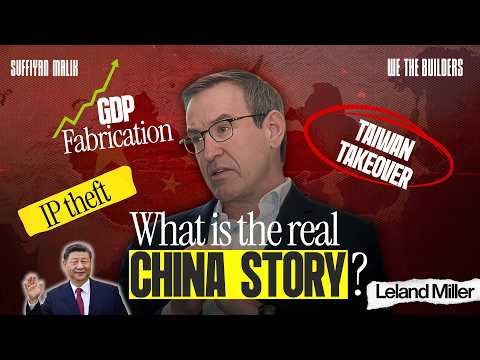
E23: Leland Miller Breaks Down the China Threat
China's Supply Chain Weaponization
China has strategically gained control over numerous critical supply chains, including rare earths, pharmaceuticals, and foundational semiconductors. This control is not merely an economic advantage but a potent tool for geopolitical leverage, allowing China to influence US policy without direct conflict. The lack of comprehensive mapping of these vulnerabilities exacerbates the risk.
Shifting Military Balance and Deterrence
The long-held belief in US military superiority over China is outdated. The current military balance suggests that both nations, along with Taiwan, may fear the outcome of a conflict, creating a precarious form of deterrence. China's rapid modernization and the US's global commitments complicate this dynamic.
China's Military Strategy
China is developing capabilities to make US intervention in a Taiwan conflict prohibitively costly by targeting aircraft carriers and airbases with long-range missiles, potentially forcing US forces to operate from extreme distances.
Critical Minerals Strategy
The US has implemented a successful strategy for critical minerals, involving equity stakes and price floors, to counter China's market manipulation and build domestic processing capacity, demonstrating a model for national security-linked industries.
Intellectual Property Theft and AI Development
China's rapid advancement in AI is fueled by significant intellectual property theft and the use of stolen technology, including advanced chips, undermining US innovation and creating a competitive disadvantage.
China's Semiconductor Vulnerability and US Policy
China's primary disadvantage lies in advanced chip manufacturing, and providing them with US-made chips undermines this vulnerability, despite arguments that it fosters dependency; robust export controls are crucial.
Leland Miller: Xi Jinping's Personal Decision-Making
Decisions regarding conflict, particularly concerning Taiwan, are ultimately driven by Xi Jinping's personal will, not necessarily by collective government consensus. His perceptions, potential fears, or external signals could trigger action.
Leland Miller: The Flawed Chinese Economic Model and Global Impact
China's economic model, driven by exports and subsidies rather than strong domestic demand, distorts global markets and decimates industries worldwide, as seen with solar panels and EVs. This 'involution' leads to overcapacity and price wars abroad.
Leland Miller: China's Strategic Investment in Critical Technologies
China is strategically investing heavily in five to six critical technology sectors, including AI, biotech, and robotics, with a national strategy to incubate companies and compete directly with the West, posing a significant commercial and potential military threat.
Leland Miller: The Difficulty of Outbound Investment Restrictions
Pushing for outbound investment restrictions in Congress has been incredibly difficult, with only minor progress made over years. While measures like CPHAS were easier, restricting outbound investments has faced significant resistance, often due to a lack of perceived seriousness about the threat.
Leland Miller: Strategic Industrial Policy vs. Economics
The US should not copy China's industrial policy but borrow from its strategic approach by identifying sectors with a national security nexus. These critical industries, like pharmaceuticals and critical minerals, should be treated as national security priorities, not purely economic matters, potentially involving price floors and government support.
Leland Miller: China's Non-Commercial Financial System
China's economy operates on a non-commercial financial system where the government can order entities to provide capital or supply, preventing liquidity freezes. While this shields the economy from immediate collapse, it leads to good money chasing bad, diverting capital from productive innovation to cover bad debt, thus slowing growth over time.
Leland Miller: China's Robotics Strategy
China's extensive use of robots, far exceeding wage rate predictions, is a strategic national security call, not just an economic one. It addresses demographic challenges, labor shortages, and enhances productivity, fitting into a broader puzzle of advanced technology development and industrial policy.
Leland Miller: China's Innovation and Talent
While China has historically been a fast follower and reverse-engineer, it is increasingly developing foundational innovations, partly due to a significant return of talent and world-class scientists. Supported by substantial funding and a STEM labor force, China is a formidable challenge in the race for technological dominance.
Miller: China's Overcapacity as a Geopolitical Weapon
China is weaponizing its industrial overcapacity, particularly in sectors like solar panels, EVs, and batteries, by dumping excess supply onto foreign markets. This strategy aims to weaken domestic production in other countries, thereby consolidating China's global economic dominance. The continuous increase in exports and production, despite theoretical limits, demonstrates a persistent strategy rather than a temporary phase.