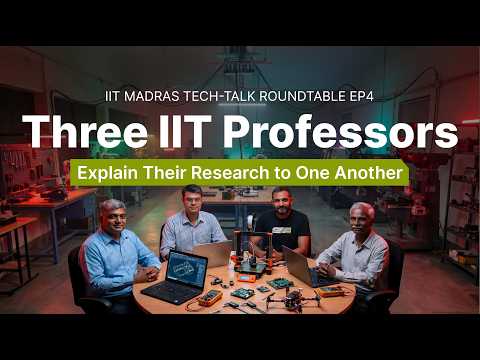
3 IIT Professors Explain their Research - StarPlat, Fitts's Law & HRV | IIT Madras Tech Talk Ep4
Amrit: AI-Powered Code Generation
AI can generate code, especially for existing languages, but human verification is still needed. For new devices, developing compilers is more feasible than creating training datasets from scratch, making compilers crucial for new hardware where data is scarce. The platform aims to abstract away device-specific complexities, allowing users to focus on high-level specifications.
Amrit & Kamlesh: Compiler Development & Usability
Developing compilers is a significant, one-time effort, but crucial for enabling domain users to leverage new devices without deep technical knowledge. The challenge lies not just in technical implementation but in making the platform usable and adopted by others. While performance can match handcrafted codes, user adoption and awareness are greater hurdles. The platform is patented but open-source for non-commercial use.
Vinky: Fitts's Law in Robotic Surgery
Fitts's Law, typically used for human-computer interaction, can be applied to robotic surgery to measure a surgeon's skill beyond mere precision. While robots excel at stability and micro-movements, human surgeons possess a nuanced 'wiggle' capability for complex maneuvers. Robotic surgery currently lacks tactile feedback, making it stressful, and future advancements may involve robots learning skills through observation rather than explicit programming.
Kamlesh & Vinky: Metrics, Gaming, and Progress
Measurements and metrics, while essential for progress and understanding (e.g., academic promotion criteria), are inherently susceptible to being 'gamed.' This phenomenon, while problematic, also drives the development of better, more nuanced metrics. The challenge is to choose metrics that align with the ultimate goals, acknowledging that each metric has trade-offs, but ultimately, better measures lead to better understanding.