Joel Greenblatt, a legendary investor, distills the essence of successful investing into a single principle: figure out what a business is worth and buy it for significantly less. This approach bypasses the need to predict market movements, focusing instead on intrinsic value. However, Green acknowledges that while simple, this principle is not easy to execute, requiring a deep understanding of business valuation that he himself initially lacked.
Munger's Strategy: Avoiding Stupidity
Charlie Munger advises focusing relentlessly on avoiding 'standard stupidities' and idiotic behavior, arguing it's easier to be non-idiotic than exceptionally smart. By identifying and consciously avoiding foolish actions that lead to negative outcomes, one gains a significant advantage. This method, applied to investing and life, helps prevent catastrophic mistakes and keeps one 'in the game.'
Prioritizing Relationships Over Wealth
Despite achieving immense financial success, the greatest investors find that the quality of their relationships, not their wealth, is the primary driver of day-to-day happiness. William Green concludes that building joyful connections with family and friends, and striving to be more loving and kind, represents the greatest investment of all.
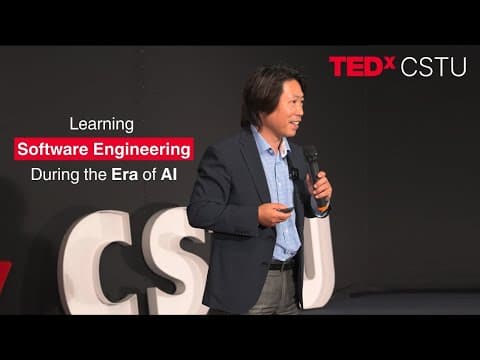
Raymond Fu highlights AI's ability to generate code, translate languages, create UIs, and fix bugs, excelling at repetitive tasks. He illustrates this with ChatGPT creating a dating app in seconds. However, AI lacks understanding of context, struggles with long-term goals, and is prone to errors, making human oversight crucial. The need for human input ensures AI remains a tool, not a replacement.
Software Engineering Beyond Coding
Software engineering involves understanding user needs, collaborating across roles, and making empathetic decisions, according to Raymond Fu. He argues that the best engineers are deep thinkers who guide machines towards meaningful outcomes. System architects should collaborate with AI, and ethical technologists must ensure solutions benefit humanity. This holistic approach defines the modern software engineer's role. The focus shifts from mere coding to strategic problem-solving.
Software Engineering Education's Evolution
Raymond Fu argues that software engineering education must evolve beyond coding to focus on problem-solving, logical thinking, and digital tool mastery. He envisions engineers as orchestrators who remove barriers and open doors. Students should master foundations, think like architects, and practice communication. This prepares them to lead in an AI-driven world. The emphasis shifts to adaptability and lifelong learning.
Raymond Fu: The Future Belongs to Deep Thinkers
Raymond Fu concludes that the future belongs to those who think deeply, adapt quickly, and collaborate efficiently, not just those who code the fastest. He redefines software engineers as visionaries, bridge builders, and leaders who guide both humans and AI. He emphasizes that software engineering is becoming the foundation of leadership. These individuals will shape the future. Their ability to innovate and connect will define progress.