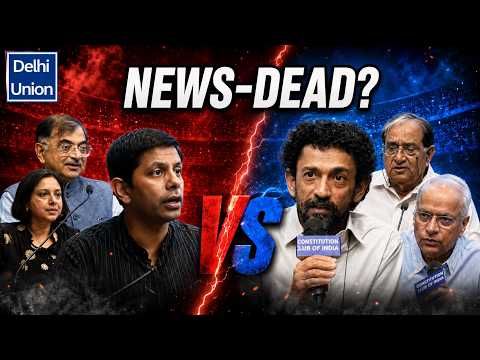
Is Indian News Dead?! Ft. Deshbhakt, Abhinandan Sekhri, Suhasini Haidar, Mr. Pachauri, Mr. Sharma+
Abhinandan Sekhri: The 'Sliver' of News Consumers
Sekhri acknowledges that there is a 'sliver of people' who want to watch news, implying that while news consumption exists, it's a minority interest compared to entertainment. He uses this to underscore the challenge mainstream media faces in retaining audience attention.
Vinod Sharma: The Proprietor's Dilemma and Economic Realities
Vinod Sharma argues that the primary culprit for mainstream media's decline is the proprietor, who is often under government thumb and makes economic models self-defeating. He highlights that newspapers selling for a nominal price incur losses, making them dependent on advertisers, who in turn dictate content.
Vinod Sharma: The Decline of Editorial Detail and Fact-Based Reporting
Sharma laments the shift away from fact-based reporting and detailed analysis, contrasting it with past journalistic standards where editors focused on accuracy and clarity. He questions who decides what constitutes a 'fact' today, implying a loss of objective truth-seeking.
Vinod Sharma: The 'Bastardization' of Debate and Loss of Editorial Voice
Sharma describes the current state of public discourse as a 'bastardization of debate,' largely contributed to by mainstream media. He argues that editors have lost their authority, and media owners, influenced by the government, dictate content and guest selection, leading to a lack of genuine journalistic courage.
Vinod Sharma: The Death of the Editor and Rise of Editorialized News
Sharma observes the 'death of the editor' and the rise of editorialized news, where every report begins with an opinion. He notes that newspapers were once sold by the editor's name, but now the byline dictates the content, indicating a loss of editorial authority and an increase in biased reporting.
Mr. Pori: Government Handouts as Lifeline
Many media companies are surviving on government advertisements and paid sponsorships, with some receiving a significant portion of their revenue from these sources. This reliance on government funding is a clear indicator of terminal decline.
Kunal: Measuring Decline and Narrative Power
The concept of 'terminal decline' needs clarification. Media's power lies in narrative creation, and if authoritarianism isn't declining, how can media serving it be in decline? The state will always support media that serves its narrative, regardless of economics.
Suhasini Haidar: Mainstream Journalism's Resilience
Mainstream journalism is not in decline; it's the media that fails to adhere to journalistic principles that will become redundant. True journalism invests in reporting, serves the public interest, holds power accountable, and requires constant commitment, not just event-based coverage.
Suhasini Haidar: Challenges to Journalism
Journalism faces significant challenges from authoritarian leadership demanding no media, corporate ownership with conflicting interests, political pressure via advertising patronage, and the rise of AI that can mimic journalistic functions.
Suhasini Haidar: The Future is Authenticity
The future of news lies in digital authentication and the demand for authentic, contextualized information. AI cannot replicate the core journalistic functions of firsthand observation, verification, and institutional memory, ensuring the continued relevance of credible journalism.
Suhasini Haidar: Mainstream Media's Decline
Suhasini Haidar argues that while some publications might be aberrations, the broader Indian media landscape is filled with outlets practicing what she considers mainstream journalism. She believes that the narrative of mainstream media's decline is only true if people stop seeking diverse information and rely solely on algorithms that reinforce existing beliefs. She asserts that people are not starved of information and that the focus on advertising revenue and 'eyeballs' is a myth, as diverse audiences seek diverse content.
Abhinandan Sekhri: Independent Media Under Attack
Abhinandan Sekhri argues that while independent media like NewsLaundry might have been dismissed as 'barking' in the past, their growing influence now makes them a target. He contends that the problem isn't just capital acquiring media, but that independent media's effectiveness is now drawing attacks, suggesting they are making a dent. However, he acknowledges that independent media won't necessarily challenge or replace mainstream media due to financial, governance, and audience issues, and that their sustenance relies on audience support.
Mr. Kra: The Erosion of Trust and Journalism's Golden Era
Mr. Kra contrasts the 'golden era' of journalism, where mainstream media was a credible public institution, with the current landscape dominated by social media, AI misinformation, and deepfakes. He highlights that tech leaders themselves admit they are not in the business of journalism or speaking truth to power, directly contributing to the erosion of public trust. He notes that while India leads in social media usage, these platforms are controlled by entities that do not prioritize journalistic ethics.
Suhasini Haidar: Authenticity of Global News Agencies
Responding to a question about why agencies like Reuters, BBC, and Al Jazeera are considered authentic despite capitalism, Suhasini Haidar differentiates their models. She notes that while the BBC is government-funded, it increasingly relies on advertising, and Al Jazeera, though credible on many stories, faces bias regarding Qatar. She emphasizes that the 'Jalmi' (media) story is important and should be covered seriously, but questions whether mainstream media in India would critically examine such events or if they would be presented as mere PR stunts, unlike how legacy papers like The Hindu approach news.
Mr. Sharma: The Decline of Investigative Journalism
Mr. Sharma asserts that investigative journalism is effectively dead, with no one actively seeking out hidden news. He contrasts the vibrant, colorful, and sometimes sensational style of some Indian TV channels with the 'Spartan' approach of the BBC, which he deems best for serious issue understanding. He criticizes the Indian media culture for its lack of accountability, citing an instance where a newspaper owner admitted being in the business of advertising, not news, and the suppression of stories that might offend advertisers.
Abhinandan Sekhri: Media Owners' Misaligned Expectations
Many traditional Indian media owners are stuck in a mindset of expecting massive profits and lavish lifestyles, failing to grasp the evolving financial models of modern journalism. They often seek to replicate existing successful models without understanding market-specific nuances, leading to a disconnect between their ambitions and the reality of the media landscape.