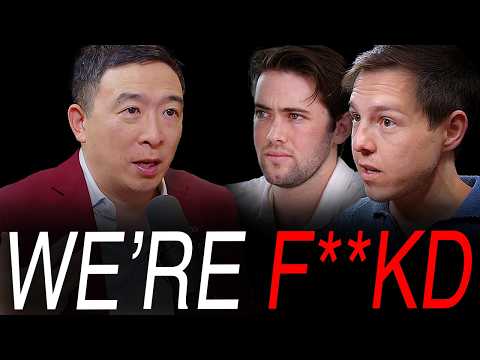
"Our Economy Is Breaking!" Andrew Yang Reveals The Biggest Threat To Money, Wealth, & Savings
Yang's Blueprint: Resilient Jobs and UBI
Yang identifies jobs that are likely to remain resilient against AI automation, including non-repetitive manual labor (like hotel cleaning or HVAC repair), creative and entrepreneurial roles, and jobs requiring significant human interaction or care (like teaching). He proposes Universal Basic Income (UBI) as a foundational solution to ensure economic participation and prevent social upheaval.
Leveraging AI: The K-Shaped Economy and Empowerment
Yang explains that the benefits of AI will disproportionately accrue to the top 20% who can leverage AI, money, and attention. He advises viewers to adopt financial principles to accumulate capital and position themselves to benefit from the AI wave, emphasizing that this is the path to empowerment in an increasingly automated world.
Guest: The Rise of High-Variance Strategies
Younger generations are increasingly adopting high-variance, speculative behaviors in investments and even gambling because traditional paths to wealth seem unattainable. They feel compelled to take extreme risks to escape mediocrity, driven by the visibility of outsized winnings in areas like crypto and sports betting.
Yang: The 'River' vs. 'Village' Economy
Yang introduces Nate Silver's concept of 'river' people (entrepreneurs, investors, gamblers who experience variable income and take big bets) versus 'village' people (stable jobs, predictable income). He identifies himself as a 'river' person, whose success came from taking significant risks after selling a company, contrasting with those seeking incremental gains.
Guest: The Inflationary Spiral of Key Sectors
Inflation is concentrated in housing, education, and healthcare, sectors often distorted by government intervention, subsidies, and lack of competition. Unlike consumer goods that become cheaper due to competition, these essential services allow price hikes because consumers are captive and often funded by loans or insurance.
Yang & Graham: Military Waste and Incentive Structures
Both Yang and Graham discuss the pervasive waste within the military, where budgets are often maintained or increased by spending allocated funds, even if it means unnecessary expenditures like dumping fuel. Yang explains this is driven by powerful incentives: military bases create jobs in congressional districts, ensuring bipartisan support for defense spending, making politicians hesitant to cut budgets for fear of job losses and political backlash. This systemic issue prevents meaningful reform, despite the clear inefficiencies.
Yang: Running for President to Educate on AI and Poverty
Yang explains his motivation for running for president was to educate the public about AI and the Fourth Industrial Revolution, aiming to accelerate the end of poverty. He believes that with rising GDP per person due to AI, society can reach a point where extreme poverty is eliminated, but only if proactive moves are made to redistribute wealth and resources, otherwise, societal disintegration is inevitable.
Yang: The Karaoke Controversy
Yang discusses how media outlets, particularly The New York Times, sought out negative anecdotes, even trivializing events like employees singing karaoke at a company party as a reason to question his fitness for office. He argues that this level of scrutiny, digging for minor past incidents or perceived slights, is excessive and disproportionate, especially when compared to the potential for finding 'rancid' statements from younger individuals on social media. The final sentence of the claim is: This intense, often trivial, scrutiny of past actions can unfairly disqualify candidates and distract from substantive policy discussions.
Yang: The Lobbying Machine
Andrew Yang describes the pervasive and lucrative nature of lobbying in Washington D.C., where significant financial investments yield massive returns. He recounts attending a breakfast with a senator where attendees had paid $5-10,000 for access, each presenting their lobbying interests. Yang contrasts this with his own lobbying for anti-poverty measures, which garnered the senator's attention. He emphasizes that the lobbying industrial complex is a powerful force, suggesting that policy is heavily influenced by those who can afford access and influence. The final sentence of the claim is: This system creates a distorted policy landscape where financial power, not public good, often dictates legislative outcomes.
Yang: Insider Trading & Hoop Adjacency
Yang discusses the prevalence of insider trading and how individuals, even those not directly in power, can gain windfalls by being 'hoop adjacent' – close enough to the centers of power to catch information about upcoming deals or events. He admits to sometimes catching wind of things before they happen, though he contrasts this with officials who are 'standing underneath the hoop' and privy to much more. He suggests that this information is often shared with family members or used to cultivate relationships with those in power. The final sentence of the claim is: This proximity to insider information, even if not directly acted upon by the individual, points to a system where information asymmetry creates unfair advantages.
Yang: Forward Party & Political Disillusionment
Yang expresses his belief that the two-party system is inadequate for addressing the nation's problems, citing the stark contrast between Congress's low approval ratings (around 15%) and its incredibly high reelection rate (94%). He highlights the public's desire for reforms like term limits and campaign finance reform, which are consistently blocked. To counter this, he co-founded the Forward Party, which now has 79 elected officials, aiming to offer a viable alternative. The final sentence of the claim is: This systemic gridlock and public dissatisfaction underscore the urgent need for alternative political structures that are more responsive to the electorate.
Political Parties & Presidential Prospects
Andrew Yang critiques the current political system, noting how major parties often shut down primaries when an incumbent is present, as seen in 2020 and 2024. He analyzes the strategic decision-making involved in choosing a party affiliation for presidential runs and identifies Gavin Newsom as a potential frontrunner against JD Vance in 2028, citing Newsom's 'president factor' and charisma. Yang also discusses the rise of charismatic, social media-savvy politicians like Zoron Manni, whose appeal to specific demographics, like renters in New York, can lead to electoral success despite controversial policies.
Taxation: Beyond Labor and Towards AI
Yang advocates for a shift in taxation away from labor income, which he believes should be encouraged, towards new sources like AI and automation. Citing the CEO of Anthropic, he suggests that taxing AI companies is a viable strategy to fund public services without hindering job growth. He argues that the competition with China in AI will be determined by factors beyond marginal tax rates, making it feasible to implement such taxes. This approach aims to capture value from technological advancements rather than penalizing human work.
The timing trap of market bubbles
The host and Yang discuss the difficulty in timing market bubbles, using the dot-com era as an example. They note that while predictions of a bubble were made years before it burst, the market continued to climb significantly higher, making early selling a missed opportunity. This highlights the challenge of knowing when to 'retrench' from an overheated market.