GED Math Practice Test - Study Guide Review Prep
Adding Fractions
To add fractions with different denominators, like 2/5 + 4/7, find a common denominator by multiplying each fraction by a form of 1 (e.g., 7/7 and 5/5). This yields 14/35 + 20/35. Then, add the numerators (14 + 20 = 34) to get the final answer: 34/35.
Circle Area and Diameter
Given a circle's area (A = πr²), its diameter (d = 2r) can be found. For an area of 81π, setting 81π = πr² yields r² = 81, so the radius r = 9. The diameter is then twice the radius: d = 2 * 9 = 18.
Surface Area of a Cylinder
The surface area of a cylinder is calculated using the formula SA = 2πr² + 2πrh. For a cylinder with radius r=7 and height h=12, substitute these values: SA = 2π(7²) + 2π(7)(12) = 2π(49) + 2π(84) = 98π + 168π = 266π.
Dividing Fractions using Keep-Change-Flip
Dividing fractions, such as 54/48 ÷ 63/35, is done using the 'Keep-Change-Flip' method: keep the first fraction, change division to multiplication, and flip the second fraction. This becomes 54/48 * 35/63. Simplify by factoring (e.g., 54=6*9, 48=6*8, 35=7*5, 63=7*9) and canceling common factors, resulting in 5/8.
Evaluating Functions
To evaluate a function f(x) = 2x² - 5x + 8 at x=4, substitute 4 for every x: f(4) = 2(4)² - 5(4) + 8. Calculate exponents (4²=16), then multiplication (2*16=32, 5*4=20), and finally addition/subtraction (32 - 20 + 8 = 20). Thus, f(4) = 20.
Solving Linear Equations
To solve the linear equation -2(3x + 4) + 5x - 32 = 3x + 1, first distribute: -6x - 8 + 5x - 32 = 3x + 1. Combine like terms: -x - 40 = 3x + 1. Isolate x by adding x to both sides (-40 = 4x + 1) and subtracting 1 from both sides (-41 = 4x). Finally, divide by 4: x = -41/4.
Factoring Quadratics: The Two-Number Method
To factor a quadratic equation like 6x² - 29x + 28, find two numbers that multiply to 168 (6 * 28) and add up to -29. These numbers are -8 and -21. The middle term (-29x) is then replaced with -8x and -21x, allowing for factoring by grouping. The GCF of the first two terms (6x² - 8x) is 2x, leaving (3x - 4). The GCF of the last two terms (-21x + 28) is -7, also leaving (3x - 4). Factoring out (3x - 4) leaves (2x - 7), resulting in the factored form (3x - 4)(2x - 7).
Solving Quadratics: The Quadratic Formula
Alternatively, quadratic equations can be solved using the quadratic formula: x = [-b ± sqrt(b² - 4ac)] / 2a. For 6x² - 29x + 28, a=6, b=-29, and c=28. Plugging these values in yields x = [29 ± sqrt((-29)² - 4*6*28)] / (2*6). This simplifies to x = [29 ± sqrt(841 - 672)] / 12, then x = [29 ± sqrt(169)] / 12, and finally x = [29 ± 13] / 12. This leads to two solutions: x = (29+13)/12 = 42/12 = 7/2, and x = (29-13)/12 = 16/12 = 4/3. This method confirms the solutions found by factoring.
Polynomial Division: Long Division Method
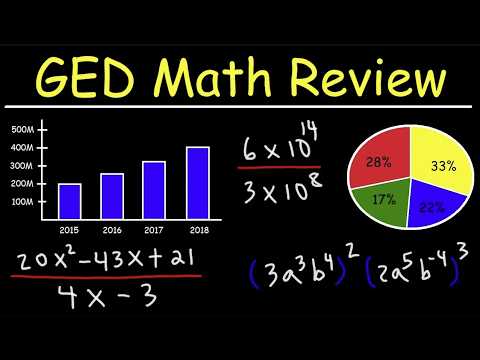
When factoring is difficult, long division can divide a trinomial by a binomial. For (20x² - 43x + 21) / (4x - 3), divide the leading term of the dividend (20x²) by the leading term of the divisor (4x) to get the first term of the quotient (5x). Multiply the quotient term by the divisor (5x * (4x - 3) = 20x² - 15x) and subtract from the dividend. Bring down the next term and repeat the process: divide -28x by 4x to get -7. Multiply -7 by (4x - 3) to get -28x + 21. Subtracting this from the remaining terms yields a remainder of zero. The quotient is 5x - 7.
Exponent Rules: Multiplication and Division
When multiplying terms with the same base, add the exponents (e.g., x² * x³ = x⁵). When dividing terms with the same base, subtract the exponents (e.g., x⁷ / x⁴ = x³). Negative exponents indicate reciprocation; x⁻³ is equivalent to 1/x³.
Exponent Rules: Power to a Power and Negative Exponents
When raising a power to another power, multiply the exponents (e.g., (x²)³ = x⁶). When simplifying expressions with negative exponents, move the base to the opposite side of the fraction bar to make the exponent positive (e.g., y⁻³ becomes 1/y³). For example, simplifying (3x²y⁻⁴ / 2x⁵z⁻³)², involves distributing the outer exponent and applying multiplication/subtraction rules, resulting in (9A²¹)/(8B⁴).