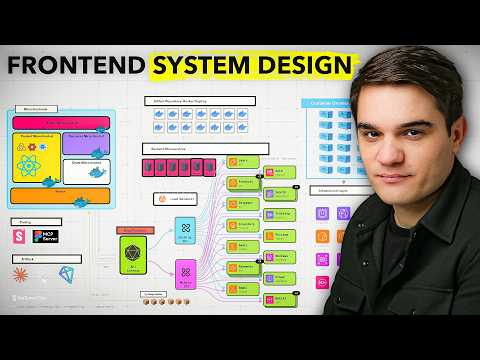
Frontend System Design Explained w/ Senior Engineer (Microfrontends, Monorepo, MCP UI, Reactjs)
The Design System Imperative
To maintain visual coherence and avoid code duplication across separate microfrontends, a robust design system is essential. This system should be built upon design tokens (like colors, fonts, borders) defined as CSS custom properties and further enhanced with reusable UI components that feature teams can readily integrate.
MCP UI and Server-Sent Events for LLM Integration
MCP UI, combined with Server-Sent Events (SSE), is the modern approach for integrating LLMs into web applications, enabling real-time, component-based responses rather than just text. SSE facilitates efficient, one-way communication from server to client, ideal for streaming LLM outputs and rendering dynamic UI elements.
Rendering Strategies: CSR vs. SSR vs. ISG
While Client-Side Rendering (CSR) is common in SPAs, it leads to slow initial loads. Server-Side Rendering (SSR) offers pre-rendered HTML but requires hydration, while Incremental Static Generation (ISG) provides a balance for dynamic content by regenerating only changed pages, making it a more efficient approach for many modern applications.
Real-Time Communication: SSE for LLM Interactions
For real-time communication, especially with LLMs, Server-Sent Events (SSE) are superior to polling or WebSockets. SSE efficiently handles the server-to-client streaming of data, which is characteristic of LLM responses, without the overhead of bidirectional communication required by WebSockets.