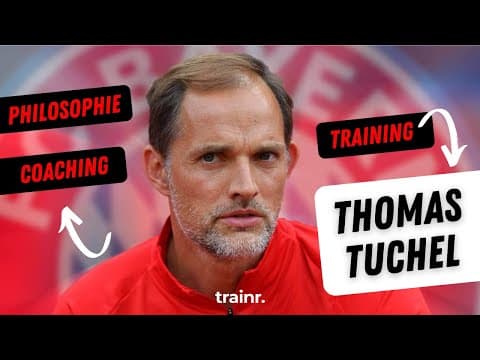
Thomas Tuchel über Training, Coaching, Ausbildung und Erfolg
Tuchel: The Art of Risk and Balance
Tuchel explains that challenging Bayern requires playing to one's own strengths while disrupting the opponent's game. This involves a delicate balance between aggressive attack and solid defense, demanding courage to take risks and exploit vulnerabilities. He illustrates this with an example of poor defensive balance leading to a penalty, underscoring the need for tactical discipline.
Tuchel's Training: Complexity and Creativity
Tuchel has moved away from repetitive, 'grinding-in' training methods towards complex, variable drills that mirror game situations. He creates challenging frameworks, often using smaller or unusually shaped fields, to force players into making quick decisions and finding novel solutions. This approach aims to enhance 'action speed' and mental agility, making the actual game feel less daunting than training.
Tuchel on Youth Development: Teamwork First
While acknowledging the need for individual skill, Tuchel emphasizes that football is fundamentally a team sport. His youth coaching philosophy, honed over years, prioritizes keeping the team together and training complex, integrated scenarios rather than isolating individual player development. This ensures players understand their roles within the collective and develop holistic game intelligence.
Effenberg: The Embodiment of Mental Fortitude
Tuchel highlights Stefan Effenberg as a prime example of a player who embodies the mental strength required to thrive under pressure. Effenberg's ability to perform at his best when the resistance was greatest, regardless of the game's stage or score, exemplifies the ideal mental resilience. This contrasts with players who might falter when conditions are not perfect or when facing setbacks. The discussion implies that such unwavering mental fortitude is a rare and crucial quality for elite athletes, enabling them to consistently deliver high performance even in the most demanding situations. This mental toughness is what separates good players from truly great ones.
The Evolving Landscape of Football and Continuous Learning
Tuchel discusses the evolving nature of football, noting how systems are becoming more similar, yet the game's attractiveness is not diminishing. He emphasizes that he is continuously learning, particularly about 'balance' and preventing counter-attacks, even with his extensive experience. He highlights Bayern's fluidity in player positions and roles as an example of this evolution, where players like Philipp Lahm can seamlessly transition between defensive and midfield duties within a single play without losing team balance. This constant adaptation and learning are essential for coaches and players alike to remain at the top. The game demands everything, and staying ahead requires a commitment to innovation and understanding new tactical nuances.
Tuchel's Coaching Philosophy: Servant Leadership and Player Empowerment
Thomas Tuchel clarifies his coaching approach, positioning himself as a 'servant leader' rather than a 'control freak.' While he has strong convictions about professional player lifestyle, including nutrition and sleep, he emphasizes that his role is not to dictate minute details but to guide and empower. He trusts specialists like chefs and physiotherapists, focusing on creating an environment where players are motivated to make optimal choices for themselves. His goal is to help players' talents shine by fostering their intrinsic motivation and making them active participants in their development. This philosophy centers on collaboration, trust, and enabling players to achieve their full potential.
Lessons from a Sabbatical: The Power of Conversation
Tuchel shares his key takeaway from his sabbatical year: the profound value of unhurried conversations. He discovered that deep, reflective discussions, allowed to 'sink in' and be revisited, are more impactful than spectacular, isolated experiences. This period provided the time to truly process insights gained from meeting diverse individuals, including those from basketball and volleyball, and from his experiences in Qatar. The ability to have these extended dialogues and reflect on them without the immediate pressure of training sessions or matches was transformative. It highlighted that meaningful learning often comes from sustained engagement and thoughtful consideration, not just from grand gestures.