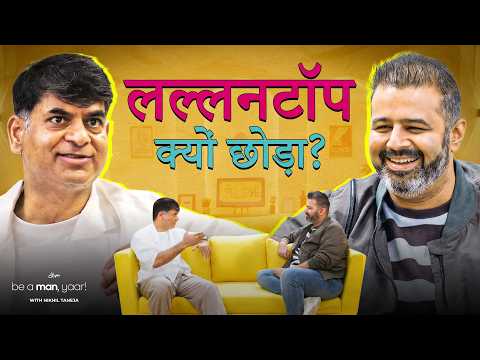
Saurabh Dwivedi on Lallantop Exit, Childhood, Masculinity, & Love | Be A Man Yaar | Nikhil Taneja
Dwivedi: Childhood in 'Beehad' Shaped Resilience
Growing up in a 'beehad' (ravine) region like Urai instilled a sense of toughness and the necessity of bravery for survival, where awareness of potential dangers like dacoits was part of daily life. This environment fostered a preference for ruggedness over superficiality.
Saurabh Dwivedi: Navigating Inter-Caste Marriage
Saurabh Dwivedi and his wife, despite societal reservations due to their different castes, pursued their marriage with parental consent, emphasizing the importance of parental blessings over societal judgment. This journey involved navigating differing ideologies while maintaining deep gratitude for their parents.
Dwivedi: Academic Achievements Amidst Financial Strain
Achieving first rank at IIMC for journalism was a significant confidence booster during a financially challenging period for his family. The support from friends, like the gift of Ramachandra Guha's book, marked this milestone as deeply special.
Dwivedi: Masculinity in a 'Beehad' Environment
In his childhood environment, masculinity was intrinsically linked to survival, bravery, and the potential for violence, symbolized by the presence of weapons like pistols. This contrasted sharply with the later realization that true respect comes from intellect and cultural understanding.
Dwivedi: The 'Judge' Within Every Indian Man
Dwivedi identifies a 'khurat judge' (rough judge) within every Indian man, operating without a degree, constantly evaluating others—especially women—based on appearance, behavior, and choices. This internal judgment is a significant aspect of toxic masculinity that needs unlearning.
Saurabh Dwivedi: Unlearning Gender Biases is Ongoing
Dwivedi asserts that unlearning gender biases is a lifelong, continuous process for men, as societal conditioning is deeply ingrained. He emphasizes that claiming to be free of bias is often a falsehood, and constant self-reflection is necessary.
Saurabh Dwivedi: The Empathy Deficit in Masculinity
Saurabh Dwivedi posits that masculinity is often not toxic because men lack empathy for others, but because they lack empathy for themselves. This internal lack of compassion leads men to judge themselves harshly for emotional expressions beyond anger, viewing vulnerability like crying as a sign of weakness.
Saurabh Dwivedi: The Transformative Power of a Teacher's Belief
Dwivedi recounts how his teacher, Aparna, provided crucial support and belief during his formative years when his family lacked faith in him. This mentorship, which extended beyond formal teaching, instilled in him the understanding of empathy and the courage to pursue his dreams, profoundly shaping his self-perception.
Nikhil Taneja: The Value of Strong-Willed Female Companionship
Nikhil Taneja advises men to consciously seek the company of strong-willed women, as they offer constructive disagreement and reasoned perspectives rather than mere agreement. He credits his wife and close female friends for challenging him and providing a crucial reality check, which he values immensely.
Nikhil Taneja: Deconstructing Male Loneliness and Societal Roles
Taneja addresses the 'male loneliness epidemic,' critiquing societal expectations that confine men to being providers and discourage nurturing roles. He argues that this rigid definition limits men's emotional expression and connection, contributing to their isolation.
Saurabh Dwivedi: The 'Abhyaranya' of True Friendship
Dwivedi describes his close male friends as 'Abhyaranya' (sanctuaries), individuals with whom he can be vulnerable and cry without judgment. These relationships, often forged through shared emotional experiences rather than just proximity, provide a vital 'safe space' for men to express their true selves.
Saurabh Dwivedi: The Father's Unspoken Influence and Legacy
Dwivedi shares a deeply personal account of his father's severe brain hemorrhage, detailing the emotional toll and the shift in family dynamics. He reflects on his father's strength, his own helplessness, and the profound realization that his father's legacy was not just about power, but about the unspoken love and sacrifices made for his children.
Nikhil Taneja: The Caregiver's Love Language
Responding to Dwivedi's story, Taneja reframes the act of caregiving in the hospital as a form of love and connection. He suggests that attending to his father's physical needs—changing clothes, brushing hair—was a profound expression of love, a different kind of 'hug' when direct physical affection was difficult.
Saurabh Dwivedi: The Foundation of a Lasting Partnership
Dwivedi describes his 15-year marriage to Gunjan as a journey that began with friendship and mutual support, especially during his financially weaker days. He emphasizes that their relationship is built on shared experiences, mutual respect, and the ability to remain friends and partners through life's ups and downs.
Nikhil Taneja: The Gradual Bloom of Love and Connection
Taneja explains that love and deep connection aren't sudden epiphanies but gradual processes. He likens it to a fever rising slowly or a banyan tree growing over time, emphasizing that it develops through shared experiences, vulnerability, and the comfort of being oneself with another person.
Saurabh Dwivedi: The Vipassana Transformation
Saurabh Dwivedi describes Vipassana meditation as a profound, life-altering experience, akin to a 'maha therapy session.' He emphasizes its scientific nature and its ability to foster self-awareness, forgiveness, and acceptance of impermanence, which significantly impacted his perspective on life and his career decisions.
Dwivedi: Leaving Lallantop for New Horizons
Saurabh Dwivedi explains his amicable departure from Lallantop, the media venture he co-founded, stating that every journey has a natural end. He expresses pride in building Lallantop and wishes his former colleagues well, highlighting the amicable separation and his desire to explore new avenues in journalism.
Dwivedi: Redefining Hindi Journalism
Saurabh Dwivedi reflects on the state of Hindi journalism before Lallantop's inception, noting its decline into sensationalism. He credits Lallantop with pioneering a new digital journalism focused on ground reporting and intellectual arguments, thereby revitalizing the landscape and catering to a public craving for substantive content.
Dwivedi: The Indian Express Advantage
Dwivedi expresses his deep respect and gratitude for The Indian Express, calling it a 'reporter's delight.' He highlights the organization's commitment to quality journalism and its nurturing environment for reporters, citing examples of exceptional work produced by its journalists.
Dwivedi: Embracing Diverse Knowledge
Saurabh Dwivedi advocates for an open-minded approach to knowledge, encouraging the study of diverse thinkers and ideologies without ideological confinement. He believes that true learning comes from engaging with a wide spectrum of ideas, rather than adhering strictly to one's own ideological 'enclosure.'
Dwivedi: The Power of Empathy and Rationality
Dwivedi posits that India's future hinges on embracing empathy and rationality, drawing strength from its rich cultural and spiritual heritage. He critiques blind faith and the expectation of miracles, advocating instead for self-reliance and a balanced approach that integrates spiritual wisdom with scientific inquiry.
Dwivedi: Building Libraries for Rural India
Dwivedi shares his dream project of establishing libraries in every Indian village, viewing them as essential as temples or water sources. He believes these libraries will foster learning, resilience, and community spirit, empowering future generations.
Dwivedi: How to Be Remembered
Saurabh Dwivedi hopes to be remembered as someone deeply in love with his roots, his country, and his friends, who continuously strives to learn and grow. He values humility, the pursuit of knowledge, and the courage to admit mistakes, seeing incompleteness as a vital part of life's journey.
Dwivedi: Redefining Masculinity and Care
Dwivedi challenges traditional notions of masculinity, advocating for men to embrace emotional vulnerability and active caregiving. He shares personal experiences of caring for his partner and emphasizes the importance of understanding women's health issues, promoting a more empathetic and supportive model of manhood.
Dwivedi: The Essence of Journalism
Dwivedi asserts that journalism is his 'soul' and 'life,' vowing never to abandon it, regardless of his other endeavors. He views it as an intrinsic part of his being, essential for his existence and purpose.