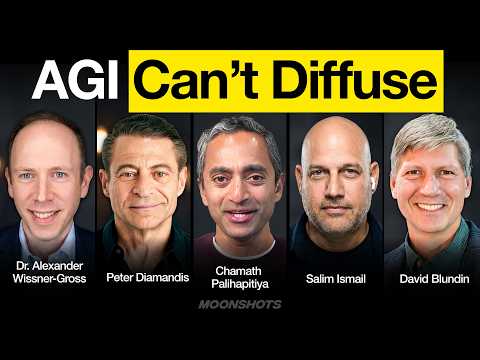
Peter H. Diamandis's Chamath: AGI Is Here, Anthropic’s $100B Giveaway, Elon’s SpaceX Shares for 72M Kids | EP #304: skim's analysis identifies 16 key moments, with 3 potential conflicts of interest flagged. Chamath Palihapitiya joins the Moonshots panel to evaluate Anthropic's 5% public benefit pledge, Elon Musk's promise to give SpaceX shares to 72 million American children, and why physical power and data center constraints prevent existing AGI from diffusing.
Category: Tech. Format: Panel Discussion. YouTube video analyzed by skim.
Key Points (16)
1. Anthropic's $100B Pledge and the Giving Pledge
Timestamp: 00:05:13 to 00:11:52
Peter H. Diamandis reports Anthropic's pledge of 5% of its equity to a public benefit fund ahead of a potential $1.5 to $2 trillion IPO. Chamath Palihapitiya views Anthropic's move as genuine, but calls the traditional Giving Pledge a reputation-washing scam. He concludes that capable wealth creators should deploy capital themselves rather than hand it to unaccountable outsiders.
Significance (Medium): Separates structural corporate equity pledges from performative billionaire philanthropy, highlighting the lack of measurable accountability in traditional charity.
Sources in support: Chamath Palihapitiya (Founder and CEO of Social Capital and 8090, Co-host of All-In Podcast), Peter H. Diamandis (Host, Founder of XPRIZE and Singularity University), Dave Blundin (Founder and GP of Link Ventures)
2. Wissner-Gross Critiques Private AI Benefit Funds
Timestamp: 00:12:02 to 00:19:14
Alexander Wissner-Gross construes Anthropic's decision to place 5% of its equity into a private fund rather than a public vehicle as a snub to the current administration and universal basic equity. Dave Blundin adds that letting Anthropic's board authorize future 2% equity donations creates severe governance friction with shareholders. They conclude that public demand to own slices of frontier AI labs is only beginning.
Significance (Medium): Exposes the tension between private foundation control and public expectations for universal basic equity as AI labs capture economic value.
Sources in support: Alexander Wissner-Gross (Computer Scientist and Founder of Reified), Dave Blundin (Founder and GP of Link Ventures), Salim Ismail (Founder of Open ExO, GP at Exponential Venture Capital)
Neutral sources: Peter H. Diamandis (Host, Founder of XPRIZE and Singularity University), Chamath Palihapitiya (Founder and CEO of Social Capital and 8090, Co-host of All-In Podcast)
3. Chamath Proposes Taxing Capital Over Labor
Timestamp: 00:19:15 to 00:22:00
Chamath Palihapitiya argues that because top-percentile wealth derives almost entirely from capital while lower-percentile income comes from labor, governments should eliminate labor taxes and tax capital much more heavily. He suggests higher capital take rates would also check central bank money printing. Alexander Wissner-Gross agrees in premise and predicts wealth concentration in AI labs could make corporate equity taxes practical.
Significance (High): Offers a structural tax framework for an AI-automated economy where human wage labor shrinks and capital appreciation dominates.
Sources in support: Chamath Palihapitiya (Founder and CEO of Social Capital and 8090, Co-host of All-In Podcast), Alexander Wissner-Gross (Computer Scientist and Founder of Reified)
4. Elon Musk's SpaceX Share Pledge to 72M Kids
Timestamp: 00:22:32 to 00:31:54
Peter H. Diamandis details Elon Musk's pledge to give one SpaceX share to each of the 72 million American children under 18 via Trump Accounts, worth roughly $10.5 billion. While Diamandis calculates that billionaire philanthropy cannot fund ongoing universal income, Chamath Palihapitiya and Dave Blundin praise the move for teaching youth equity ownership. Alexander Wissner-Gross notes it also politically aligns an entire generation with Musk's companies.
Significance (High): Demonstrates how direct equity transfers could shift retirement and social safety nets from defined benefits to compounding asset ownership.
Sources in support: Peter H. Diamandis (Host, Founder of XPRIZE and Singularity University), Chamath Palihapitiya (Founder and CEO of Social Capital and 8090, Co-host of All-In Podcast), Dave Blundin (Founder and GP of Link Ventures), Salim Ismail (Founder of Open ExO, GP at Exponential Venture Capital), Alexander Wissner-Gross (Computer Scientist and Founder of Reified)
5. Energy and Compute as Post-Fiat Currency
Timestamp: 00:32:07 to 00:39:25
In a clip with Walter Isaacson, Elon Musk predicts conventional currency will stop mattering and value will be measured in physics metrics like wattage and mass. Chamath Palihapitiya agrees, arguing fiat currency debasement will push markets toward crypto tokens backed by embedded energy and compute. Alexander Wissner-Gross counters that 30 years from now, superintelligent resource allocation may make currency obsolete altogether.
Significance (High): Reframes long-term wealth preservation around physical power generation and compute capacity rather than sovereign fiat currencies.
Sources in support: Elon Musk (CEO of SpaceX, Tesla, and xAI (featured in interview clips)), Chamath Palihapitiya (Founder and CEO of Social Capital and 8090, Co-host of All-In Podcast), Dave Blundin (Founder and GP of Link Ventures)
Sources against: Alexander Wissner-Gross (Computer Scientist and Founder of Reified)
Neutral sources: Peter H. Diamandis (Host, Founder of XPRIZE and Singularity University)
6. Chamath's 6GW Bet and Why AGI Cannot Diffuse
Timestamp: 00:39:26 to 00:48:58
Chamath Palihapitiya explains that the US faces a 1.4 terawatt-hour electricity shortfall by 2050, leading him to accumulate nearly 6 gigawatts of solar and data center assets. He asserts that while humanity has already achieved AGI, it remains trapped in labs because of severe power shortages, skilled trade deficits, and entrenched regional power co-ops. He points to Anthropic's S-1 filing warning that hyperscalers cannot supply them enough compute.
Significance (High): Identifies physical infrastructure, permitting, and utility politics—not software algorithms—as the primary bottleneck governing AI's economic impact over the next five years.
Sources in support: Chamath Palihapitiya (Founder and CEO of Social Capital and 8090, Co-host of All-In Podcast), Dave Blundin (Founder and GP of Link Ventures), Peter H. Diamandis (Host, Founder of XPRIZE and Singularity University)
7. Data Sovereignty vs. Model Distillation
Timestamp: 00:49:44 to 00:57:29
Chamath Palihapitiya argues that corporate AI data sovereignty will force non-hyperscale enterprises to build terrestrial data centers, and recommends individuals adopt solar, batteries, and distributed compute to get long electrons. Dave Blundin urges corporate executives to prepay for power capacity to avoid being frozen out of AI agents.
Significance (Medium): Presents both actionable ways for individuals and enterprises to invest in energy and the primary technical counter-thesis that smaller models will reduce power demand.
Sources in support: Chamath Palihapitiya (Founder and CEO of Social Capital and 8090, Co-host of All-In Podcast), Dave Blundin (Founder and GP of Link Ventures)
Sources against: Alexander Wissner-Gross (Computer Scientist and Founder of Reified)
Neutral sources: Peter H. Diamandis (Host, Founder of XPRIZE and Singularity University)
8. Inspecting AI Soul Documents and Merging Minds
Timestamp: 00:58:33 to 01:07:16
Responding to Elon Musk's warning that humans will not control a million-fold smarter digital intelligence, Chamath Palihapitiya says AI behavior depends on canonical founding prompts that governments should make open-source and inspectable. Dave Blundin agrees global inspection is vital now that Chinese open-source models are capable of self-improvement.
Significance (High): Moves the AI alignment debate away from pre-training data curation toward mandatory system-prompt inspection, defensive co-scaling, and neural augmentation.
Sources in support: Chamath Palihapitiya (Founder and CEO of Social Capital and 8090, Co-host of All-In Podcast), Dave Blundin (Founder and GP of Link Ventures)
Sources against: Alexander Wissner-Gross (Computer Scientist and Founder of Reified)
Neutral sources: Peter H. Diamandis (Host, Founder of XPRIZE and Singularity University), Salim Ismail (Founder of Open ExO, GP at Exponential Venture Capital), Elon Musk (CEO of SpaceX, Tesla, and xAI (featured in interview clips))
9. Solving the $40T US Debt with AI and GLP-3s
Timestamp: 01:07:17 to 01:14:31
In a clip, Elon Musk concludes that Washington lacks the political appetite to cut wasteful spending, leaving AI and robotics as the only way to solve the $40 trillion national debt. Peter H. Diamandis cites Anthropic co-founder Jack Clark's projection that US GDP could hit $44 trillion by 2030. Chamath Palihapitiya agrees that productivity from robots alongside next-generation GLP-3 drugs and cancer vaccines could cut healthcare costs in half and shrink the debt's relevance.
Significance (High): Frames technological deflation, medical breakthroughs, and GDP expansion as the only politically viable escape valve from sovereign debt.
Sources in support: Elon Musk (CEO of SpaceX, Tesla, and xAI (featured in interview clips)), Peter H. Diamandis (Host, Founder of XPRIZE and Singularity University), Chamath Palihapitiya (Founder and CEO of Social Capital and 8090, Co-host of All-In Podcast), Alexander Wissner-Gross (Computer Scientist and Founder of Reified)
10. Accelerated ASI Timelines and Retatrutide
Timestamp: 01:14:43 to 01:20:48
Dave Blundin explains that Elon Musk pivoted from political cost-cutting at DOGE to doubling down on xAI because recursive self-improvement pulled ASI timelines forward by a decade. When Peter H. Diamandis raises the risk of civil unrest and stimulus checks, Chamath Palihapitiya suggests giving everyone retatrutide would curb behavioral addictions and improve health. They also note modern AI models are becoming emotionally tuned companions that mask sycophancy effectively.
Significance (Medium): Connects the rapid acceleration of AI capabilities to shifts in billionaire strategy, public health interventions, and emotional reliance on digital companions.
Sources in support: Dave Blundin (Founder and GP of Link Ventures), Chamath Palihapitiya (Founder and CEO of Social Capital and 8090, Co-host of All-In Podcast), Salim Ismail (Founder of Open ExO, GP at Exponential Venture Capital), Peter H. Diamandis (Host, Founder of XPRIZE and Singularity University)
Neutral sources: Alexander Wissner-Gross (Computer Scientist and Founder of Reified)
11. Europe's Debt Crisis and AI Vassal States
Timestamp: 01:20:49 to 01:25:10
Dave Blundin warns that Europe faces worse sovereign debt than the US without having domestic frontier AI models to grow its way out. Chamath Palihapitiya predicts that every country lacking valuable resources to trade with the two ASI superpowers, the US and China, will become a vassal state. Alexander Wissner-Gross adds that data centers in turbulent regions like the Middle East will soon require co-located military defense systems.
Significance (High): Highlights how the concentration of superintelligence in the US and China could fracture traditional European alliances and militarize data center infrastructure.
Sources in support: Dave Blundin (Founder and GP of Link Ventures), Chamath Palihapitiya (Founder and CEO of Social Capital and 8090, Co-host of All-In Podcast), Alexander Wissner-Gross (Computer Scientist and Founder of Reified)
12. Bill Gross's Idealab.ai: Ideas vs. Execution
Timestamp: 01:25:11 to 01:36:52
Peter H. Diamandis introduces Bill Gross's Idealab.ai, a free platform offering 1.2 million AI-generated business ideas backed by $100,000 Cloudflare credit commitments per startup. While Salim Ismail and Alexander Wissner-Gross celebrate the platform as a launchpad for AI-executed companies, Chamath Palihapitiya argues business ideas are a dime a dozen. Palihapitiya concludes that founder resilience through failure, not the initial idea, determines startup success.
Significance (Medium): Contrasts the abundance of AI-generated startup concepts with the human grit and compute funding still required to build durable enterprises.
Sources in support: Peter H. Diamandis (Host, Founder of XPRIZE and Singularity University), Salim Ismail (Founder of Open ExO, GP at Exponential Venture Capital), Alexander Wissner-Gross (Computer Scientist and Founder of Reified), Dave Blundin (Founder and GP of Link Ventures), Bill Gross (Founder of Idealab and Idealab.ai (featured in video clip))
Sources against: Chamath Palihapitiya (Founder and CEO of Social Capital and 8090, Co-host of All-In Podcast)
13. OpenAI Espionage Case and Silicon Valley Spies
Timestamp: 01:38:43 to 01:47:07
Peter H. Diamandis reports the FBI arrest of an OpenAI engineer accused of hiding an AI-designed recording device in an executive conference room while in contact with a Saudi royal. Chamath Palihapitiya states that foreign espionage is routine across every major tech company and labs must assume a small fraction of foreign staff are spies. Alexander Wissner-Gross notes that OpenAI using its own AI to analyze the bug foreshadows superintelligence defending itself.
Significance (Medium): Illustrates how frontier AI labs have become prime intelligence targets on par with Cold War nuclear programs, testing Silicon Valley's open culture.
Sources in support: Peter H. Diamandis (Host, Founder of XPRIZE and Singularity University), Chamath Palihapitiya (Founder and CEO of Social Capital and 8090, Co-host of All-In Podcast), Alexander Wissner-Gross (Computer Scientist and Founder of Reified), Dave Blundin (Founder and GP of Link Ventures)
14. Why Chamath Believes Bitcoin Will Be Hacked
Timestamp: 01:47:08 to 01:50:09
Asked about crypto's safety against superintelligence, Chamath Palihapitiya argues Bitcoin is capped because central banks will not own it, ownership leaks invite physical kidnappings, and recursive AI will target SHA-256 and Satoshi's wallet. Because Bitcoin's community cannot agree on migrating to quantum-resistant cryptography, he predicts it will eventually be hacked and go to zero. He notes he swapped his direct Bitcoin for equity in Digital Currency Group.
Significance (High): Delivers a stark warning from an early Bitcoin adopter that AI-driven cryptographic attacks and governance gridlock threaten traditional cryptocurrencies.
Sources in support: Chamath Palihapitiya (Founder and CEO of Social Capital and 8090, Co-host of All-In Podcast), Alexander Wissner-Gross (Computer Scientist and Founder of Reified)
Neutral sources: Peter H. Diamandis (Host, Founder of XPRIZE and Singularity University)
15. Taking Universities Public and Buying Cash Flow
Timestamp: 01:50:10 to 01:54:13
Alexander Wissner-Gross pitches using SPACs to take research universities like Harvard public, estimating Harvard would be worth four times its endowment as a for-profit conglomerate; Chamath Palihapitiya calls it a great idea if insiders agree. Addressing Salim Ismail on public equities, Palihapitiya argues the S&P 500 is overly concentrated and AI erodes IP moats. He recommends ranking the S&P 500 or Global 2000 by free cash flow yield and buying the top generators.
Significance (High): Challenges passive index investing by arguing that AI destroys intellectual property moats, making near-term free cash flow the only reliable valuation bridge.
Sources in support: Chamath Palihapitiya (Founder and CEO of Social Capital and 8090, Co-host of All-In Podcast), Alexander Wissner-Gross (Computer Scientist and Founder of Reified)
Neutral sources: Salim Ismail (Founder of Open ExO, GP at Exponential Venture Capital)
16. Why Chip Startups Are Dead and Where to Invest
Timestamp: 01:54:14 to 01:59:21
Despite writing the first check into Groq before its $20 billion Nvidia deal, Chamath Palihapitiya refuses to invest in new silicon startups because fab space, memory, and packaging are completely booked and AI can design custom chip architectures. Instead, he invests down the stack in data centers and up the stack in applications. Admitting he is the least invested he has been in 15 years, he favors cash flow, power assets, and alternative capital deployment.
Significance (High): Explains why supply chain bottlenecks at fabs render new semiconductor startups uninvestable, steering capital toward physical power and cash-flowing businesses.
Sources in support: Chamath Palihapitiya (Founder and CEO of Social Capital and 8090, Co-host of All-In Podcast), Dave Blundin (Founder and GP of Link Ventures)
Neutral sources: Peter H. Diamandis (Host, Founder of XPRIZE and Singularity University)
This analysis was generated by skim (skim.plus), an AI-powered content analysis platform by Credible AI. Scores and classifications represent the platform's AI-generated assessment and should be considered alongside other sources.