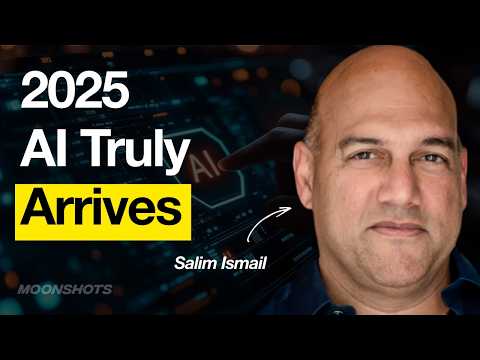
Peter H. Diamandis's The New Administration Means Major Change for Crypto, AI & Tech w/ Salim Ismail | EP #143: skim's analysis identifies 13 key moments, with 3 potential conflicts of interest flagged. Peter and Salim Ismail forecast how the incoming Trump administration and early 2025 tech breakthroughs could reshape spaceflight, AI, energy, materials science, crypto, and robotics.
Category: Tech. Format: Panel Discussion. YouTube video analyzed by skim.
skim AI Analysis
Credibility assessment: Tech-Insider Speculation. Peter and Salim Ismail cite real corporate announcements, flight milestones, and market figures from SpaceX, Nvidia, Microsoft, and MicroStrategy. However, much of the runtime blends these news hooks with sweeping personal predictions about geopolitics, AGI timelines, and unproven commercial outcomes, plus host-read ads for affiliated companies.
Bias assessment: Techno-Optimist Deregulation. Both speakers share an explicit pro-abundance, techno-optimist worldview. They consistently champion rapid deregulation across biotech, energy, and cryptocurrency, celebrate billionaire-led space and AI ventures as the primary engines of human progress, and treat governmental oversight largely as an inefficiency for AI to strip away.
Originality: 68% — Curated Tech Synthesis. While the core segments react to public news from CES 2025, SpaceX, and Microsoft, the hosts add distinctive personal anecdotes, back-of-the-envelope physics thought experiments, and Salim Ismail's deeply personal account of his father's assisted death in Canada.
Depth: 64% — Broad Trend Spotting. The conversation covers a wide slate of frontier technologies, connecting hardware platforms to software and policy implications. Still, it favors high-level enthusiasm and rapid-fire forecasting over granular technical scrutiny or rigorous examination of economic and regulatory trade-offs.
Key Points (13)
1. Salim Ismail Predicts Grand Deals and Crypto UBI
Timestamp: 00:00:00 to 00:02:23
Salim Ismail predicts the incoming Trump administration could strike grand geopolitical bargains over Taiwan and Ukraine, back a crypto-based universal basic income, and enact temporary housing code hacks to rebuild Los Angeles. Both hosts agree a tech-forward White House will accelerate change.
Significance (Medium): Framing geopolitical conflicts and disaster recovery as deal-making and regulatory hacks highlights how tech strategists expect unconventional executive action.
Sources in support: Salim Ismail (Founding Executive Director of Singularity University, Founder and Chairman of ExO Works and OpenExO), Peter (Host, Co-founder of Fountain Life and Singularity University)
2. Biotech Deregulation and Bitcoin Reserves
Timestamp: 00:02:25 to 00:07:43
Peter predicts the Trump administration will push humans toward the Moon and Mars, deregulate biotech while tightening food standards under Bobby Kennedy, double energy output, use AI to cut regulation, and embrace Bitcoin reserves. Salim Ismail enthusiastically backs all five predictions.
Significance (High): Pairing biotech and energy deregulation with strict food rules outlines the policy agenda favored by Silicon Valley backers of the new administration.
Sources in support: Peter (Host, Co-founder of Fountain Life and Singularity University), Salim Ismail (Founding Executive Director of Singularity University, Founder and Chairman of ExO Works and OpenExO)
3. Starship's Booster Catch and Upper Stage Loss
Timestamp: 00:08:23 to 00:11:52
On Starship's seventh test flight, SpaceX caught the returning Super Heavy booster with its launch tower arms, though the upper stage broke apart from a suspected fuel leak. Peter and Salim Ismail view the booster catch as a historic engineering feat and treat the ship loss as normal iterative testing.
Significance (High): Routine recovery of the largest rocket booster ever flown validates rapid reusability, even as upper-stage failures show orbital reentry remains unforgiving.
Sources in support: Peter (Host, Co-founder of Fountain Life and Singularity University), Salim Ismail (Founding Executive Director of Singularity University, Founder and Chairman of ExO Works and OpenExO)
4. Blue Origin's New Glenn Challenges Legacy Launch
Timestamp: 00:11:53 to 00:16:44
Within 12 hours of Starship's flight, Blue Origin launched its orbital New Glenn rocket after 12 years of development. Peter argues SpaceX and Blue Origin will overtake legacy defense contractors like Lockheed Martin and Boeing while cutting launch costs 100-fold to unlock asteroid mining and orbital colonies.
Significance (High): Two competing heavy-lift reusable systems breaking the legacy aerospace duopoly could slash payload costs and make off-world resource extraction viable.
Sources in support: Peter (Host, Co-founder of Fountain Life and Singularity University), Salim Ismail (Founding Executive Director of Singularity University, Founder and Chairman of ExO Works and OpenExO)
5. Peter Calculates $150 Electricity Cost to Orbit
Timestamp: 00:16:50 to 00:20:48
Using Gemini 1.5 Pro to check a physics thought experiment, Peter calculates that the pure electrical energy required to winch a 250-kilogram astronaut and suit to a 200-kilometer orbit at 20 cents per kilowatt-hour costs roughly $150. He concludes chemical rockets are grossly inefficient compared to future concepts.
Significance (Low): Contrasting $150 in raw potential and kinetic energy against multi-million-dollar rocket launches illustrates how much efficiency headroom remains in space transport.
Sources in support: Peter (Host, Co-founder of Fountain Life and Singularity University), Salim Ismail (Founding Executive Director of Singularity University, Founder and Chairman of ExO Works and OpenExO)
6. Nvidia's Cosmos and $3,000 Digits Supercomputer
Timestamp: 00:22:38 to 00:30:57
At CES 2025, Nvidia unveiled the Cosmos platform for autonomous robots and Project Digits, a $3,000 desktop AI supercomputer stated to be 1,000 times more powerful than an average laptop. Salim Ismail says local supercomputing shatters Moore's Law and exposes how unprepared society and legal systems are.
Significance (High): Putting petaflop-scale AI training hardware on a desk for $3,000 shifts the competitive bottleneck from compute access to proprietary datasets and legal liability.
Sources in support: Peter (Host, Co-founder of Fountain Life and Singularity University), Salim Ismail (Founding Executive Director of Singularity University, Founder and Chairman of ExO Works and OpenExO)
7. Enterprise AI Agents and Minimum Viable Policy
Timestamp: 00:31:05 to 00:37:24
Peter notes ChatGPT reached 300 million weekly users and cites Marc Benioff reporting a 30% engineering productivity gain at Salesforce using Agentforce 2.0 without new hires. Both hosts dismiss Sam Altman's call for gradual AI deployment as moat-building, urging governments to use AI for minimum viable policy.
Significance (High): Deploying AI agents to freeze engineering headcount while rewriting tax and regulatory codes threatens white-collar service industries with rapid demonetization.
Sources in support: Peter (Host, Co-founder of Fountain Life and Singularity University), Salim Ismail (Founding Executive Director of Singularity University, Founder and Chairman of ExO Works and OpenExO)
8. Shifting AGI Goalposts and the Fusion vs Solar Race
Timestamp: 00:37:25 to 00:42:18
Reacting to Sam Altman's blog claiming OpenAI knows how to build AGI and expects net-gain fusion soon from Helion, Peter argues humanity will pass AGI within six months while constantly moving the goalposts. Salim Ismail counters that high-efficiency solar and storage will beat commercial fusion.
Significance (Medium): Even without consensus on what defines AGI, applying advanced AI to magnetic confinement and materials is accelerating the race against solar plus storage.
Sources in support: Peter (Host, Co-founder of Fountain Life and Singularity University)
Sources against: Salim Ismail (Founding Executive Director of Singularity University, Founder and Chairman of ExO Works and OpenExO)
9. Salim Ismail Expects Near-Zero Marginal Energy Costs
Timestamp: 00:44:40 to 00:47:55
Examining solar perovskite cells, fail-safe fourth-generation small modular nuclear reactors, and coal, Peter warns that flat US energy production lags behind China and India. Salim Ismail argues solar and nuclear advances will soon drive electricity costs toward zero across nations.
Significance (Medium): If perovskite solar and small modular reactors push electricity toward zero marginal cost, national competitiveness shifts from energy scarcity to compute capacity.
Sources in support: Salim Ismail (Founding Executive Director of Singularity University, Founder and Chairman of ExO Works and OpenExO)
Sources against: Peter (Host, Co-founder of Fountain Life and Singularity University)
10. Microsoft's MatterGen Model and Molecular Assembly
Timestamp: 00:47:56 to 00:56:15
Microsoft published MatterGen in Nature, a generative AI model that designs novel materials from desired property prompts rather than screening existing candidates. Salim Ismail calls it the AlphaFold of materials science, predicting rapid breakthroughs in batteries, carbon capture, and molecular manufacturing.
Significance (High): Generating custom atomic structures on demand replaces slow trial-and-error lab screening, accelerating clean energy catalysts while raising bio- and nano-safety risks.
Sources in support: Peter (Host, Co-founder of Fountain Life and Singularity University), Salim Ismail (Founding Executive Director of Singularity University, Founder and Chairman of ExO Works and OpenExO)
11. Google's Gemini Deep Research and Bitcoin Leverage
Timestamp: 00:56:21 to 01:05:15
Peter praises Google's $20-per-month Gemini Deep Research tool for compiling multi-page reports in minutes, before highlighting MicroStrategy's acquisition of 1,070 Bitcoin and its 693% one-year return versus Bitcoin's 144%. The hosts also debate a proposed $20 billion US Bitcoin reserve, which Salim Ismail calls too small.
Significance (Medium): Autonomous research agents compress hours of synthesis into minutes, while corporate debt-fueled Bitcoin accumulation amplifies both upside returns and downside risk.
Sources in support: Peter (Host, Co-founder of Fountain Life and Singularity University), Salim Ismail (Founding Executive Director of Singularity University, Founder and Chairman of ExO Works and OpenExO)
12. Unitree's $16,000 Humanoid and Tesla's Scaling Goal
Timestamp: 01:05:49 to 01:13:42
Showcasing Shenzhen-based Unitree's $16,000 G1 humanoid robot, Nvidia's GR00T imitation-learning blueprint, and Elon Musk's target of 500,000 Optimus robots within three years, Peter forecasts rapid adoption. Salim Ismail questions the humanoid form factor and warns of chaotic household glitches and lawsuits.
Significance (High): Combining $16,000 hardware with shared imitation-learning datasets brings general-purpose robots within consumer reach, though physical safety and liability remain unresolved.
Sources in support: Peter (Host, Co-founder of Fountain Life and Singularity University)
Sources against: Salim Ismail (Founding Executive Director of Singularity University, Founder and Chairman of ExO Works and OpenExO)
13. Salim Ismail on His Father's Assisted Death
Timestamp: 01:13:45 to 01:18:07
Salim Ismail recounts the assisted death of his 97-year-old father in Canada, describing how having agency to schedule his passing while listening to Beethoven's Ninth Symphony produced a state of bliss rather than grief. He argues society should rethink the religious stigma around assisted dying.
Significance (Medium): Sharing a firsthand account of medical assistance in dying contrasts longevity tech with end-of-life agency, challenging cultural taboos around how people choose to die.
Sources in support: Salim Ismail (Founding Executive Director of Singularity University, Founder and Chairman of ExO Works and OpenExO), Peter (Host, Co-founder of Fountain Life and Singularity University)
This analysis was generated by skim (skim.plus), an AI-powered content analysis platform by Credible AI. Scores and classifications represent the platform's AI-generated assessment and should be considered alongside other sources.