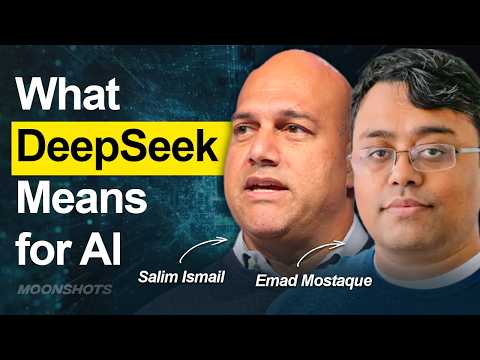
Peter H. Diamandis's DeepSeek vs. Open AI - The State of AI w/ Emad Mostaque & Salim Ismail | EP #146: skim's analysis identifies 12 key moments, with 2 potential conflicts of interest flagged. Emad Mostaque, Salim Ismail, and Peter examine how DeepSeek achieved frontier AI reasoning at a fraction of typical training costs through engineering optimization and memory scaling under hardware constraints.
Category: Tech. Format: Panel Discussion. YouTube video analyzed by skim.
skim AI Analysis
Credibility assessment: Expert Industry Perspective. Emad Mostaque provides technical insights grounded in his direct experience building AI clusters at Stability AI. However, the discussion also includes broad, unverified macro-economic predictions, back-of-the-envelope energy calculations, and promotional segments for both Intelligent Internet and host-read health sponsors.
Bias assessment: Open-Source Accelerationist. The panel strongly favors open-source AI development and techno-optimist abundance narratives. Emad Mostaque actively critiques closed corporate labs like OpenAI and Anthropic while promoting his own open-source venture, Intelligent Internet, as the necessary path for human flourishing.
Originality: 82% — Insider Technical Synthesis. Rather than repeating standard media panic over DeepSeek, Emad Mostaque breaks down the specific hardware constraints, PTX coding optimizations, and memory scaling that enabled the breakthrough, connecting these technical realities to broader economic and societal shifts.
Depth: 80% — Multi-Layered Tech Analysis. The conversation moves effectively from low-level GPU architecture and synthetic data generation to geopolitical game theory, labor market disruption in the outsourcing sector, and the philosophical crisis of human meaning in a post-labor economy.
Key Points (12)
1. Visible reasoning drove DeepSeek R1's viral surge
Timestamp: 00:02:49 to 00:07:37
Emad Mostaque explains that DeepSeek's viral explosion stemmed from combining its low-cost V3 base model with the R1 reasoning model. Unlike OpenAI's o1, which hid its thinking process, R1 displayed its step-by-step Chain of Thought to users and launched as open source so people could run smaller versions on laptops. This confluence of visible reasoning, benchmark parity, and immediate accessibility triggered a massive narrative cascade.
Significance (High): Visible chain-of-thought reasoning shifts user perception of AI from a black-box oracle to a transparent collaborator, accelerating grassroots adoption and developer trust.
Sources in support: Emad Mostaque (Founder of Intelligent Internet, former CEO and Co-Founder of Stability AI), Salim Ismail (Co-host, Founder and Chairman of OpenExO, Founding Executive Director of Singularity University)
Neutral sources: Peter (Host of Moonshots podcast)
2. US chip sanctions forced DeepSeek's efficiency
Timestamp: 00:07:38 to 00:14:30
Emad Mostaque argues that DeepSeek's 96% cost reduction and sub-$6 million training run are credible engineering achievements born from hardware constraints. Restricted to Nvidia H800 chips with slower interconnect speeds, DeepSeek's engineers wrote low-level PTX code and scaled model memory using a sparse 640-billion-parameter architecture where only 30 billion parameters activate at once. They also relied on high-quality synthetic data rather than massive brute-force compute.
Significance (High): Hardware sanctions failed to halt Chinese AI progress and instead catalyzed algorithmic and memory optimizations that undermine the brute-force compute moat of US tech giants.
Sources in support: Emad Mostaque (Founder of Intelligent Internet, former CEO and Co-Founder of Stability AI), Peter (Host of Moonshots podcast), Salim Ismail (Co-host, Founder and Chairman of OpenExO, Founding Executive Director of Singularity University)
3. Mostaque disputes claims of OpenAI distillation
Timestamp: 00:14:30 to 00:18:48
Responding to a clip of David Sacks claiming DeepSeek distilled its knowledge from OpenAI's models, Emad Mostaque counters that DeepSeek primarily generated its own synthetic data using reinforcement learning similar to AlphaGo Zero on its R1-Zero model. Because OpenAI hid the Chain of Thought reasoning in o1 outputs, DeepSeek could not simply copy that reasoning step from OpenAI.
Significance (Medium): Self-generated synthetic training data via reinforcement learning allows labs to bootstrap frontier reasoning capabilities without relying on human-labeled datasets or competitor API outputs.
Sources in support: Emad Mostaque (Founder of Intelligent Internet, former CEO and Co-Founder of Stability AI), Salim Ismail (Co-host, Founder and Chairman of OpenExO, Founding Executive Director of Singularity University)
Sources against: David Sacks (Tech commentator featured in video clip)
Neutral sources: Peter (Host of Moonshots podcast)
4. Smartphone-level reasoning on 20 watts by 2026
Timestamp: 00:18:55 to 00:22:30
Emad Mostaque calculates that using Nvidia's new integrated NVL72 data center boxes, training a DeepSeek-scale model requires at most four to ten boxes and roughly 1,000 megawatt-hours of electricity costing around $15,000 to $20,000. He projects that as optimization continues, by 2026 users will run o1-level PhD-capable models locally on smartphones pulling at most 20 watts of power.
Significance (High): Plummeting inference energy requirements will move frontier intelligence from centralized hyperscale data centers directly onto edge devices and consumer hardware.
Sources in support: Emad Mostaque (Founder of Intelligent Internet, former CEO and Co-Founder of Stability AI), Peter (Host of Moonshots podcast)
Neutral sources: Salim Ismail (Co-host, Founder and Chairman of OpenExO, Founding Executive Director of Singularity University)
5. Why DeepSeek boosts OpenAI and favors small teams
Timestamp: 00:22:30 to 00:32:02
Addressing enterprise privacy concerns over Chinese models, Emad Mostaque notes that US providers like Perplexity already host DeepSeek on American servers, though regulated industries will require fully auditable open-data stacks to prevent sleeper-agent poisoning. Rather than hurting OpenAI, Mostaque believes cheaper training will boost OpenAI's valuation by slashing its $3 billion annual training burn while it leverages its 300-to-400-million user base.
Significance (Medium): Commoditized pre-training shifts competitive advantage toward consumer distribution and user feedback loops while enabling small research teams to rival tech giants.
Sources in support: Emad Mostaque (Founder of Intelligent Internet, former CEO and Co-Founder of Stability AI), Salim Ismail (Co-host, Founder and Chairman of OpenExO, Founding Executive Director of Singularity University)
Neutral sources: Peter (Host of Moonshots podcast)
6. Chip sovereignty and the 3-to-5-year AGI race
Timestamp: 00:32:06 to 00:39:59
Emad Mostaque explains that While Nvidia chips remain superior to AMD, China successfully runs DeepSeek inference on domestic Huawei Ascend 910 chips and operates exascale supercomputers, prompting the US to use tariffs and initiatives like the $500 billion Stargate project to onshore compute. As domestic Chinese rivals like Alibaba's Qwen 2.5 Max accelerate the race, Mostaque notes a consensus among AI leaders that AGI is 3 to 5 years away.
Significance (High): National competitiveness now hinges on domestic compute capacity and energy, locking the US and China into an unavoidable game-theoretic race toward AGI.
Sources in support: Emad Mostaque (Founder of Intelligent Internet, former CEO and Co-Founder of Stability AI), Peter (Host of Moonshots podcast), Salim Ismail (Co-host, Founder and Chairman of OpenExO, Founding Executive Director of Singularity University)
7. Remote AI workers will break labor-energy links
Timestamp: 00:40:00 to 00:46:37
Defining AGI as a system that outperforms a human team, Emad Mostaque introduces Artificial Remote Intelligence (ARI), noting that AI can already pass as a human coworker on Zoom and Slack. He contrasts today's AI 'cooks' that follow instructions with incoming AGI 'chefs' that invent new solutions, noting that untuned models like R1 are already synthesizing academic papers into new algorithms.
Significance (High): When digital agents can seamlessly occupy remote team roles and generate novel scientific research, traditional economic models tying GDP growth to human labor hours break down.
Sources in support: Emad Mostaque (Founder of Intelligent Internet, former CEO and Co-Founder of Stability AI), Peter (Host of Moonshots podcast), Salim Ismail (Co-host, Founder and Chairman of OpenExO, Founding Executive Director of Singularity University)
8. 2025 outlook: BPO collapse and remote job loss
Timestamp: 00:46:38 to 00:54:10
Weighing the best and worst outcomes for 2025, Emad Mostaque predicts that AI will enable custom studio-quality video episodes, empathetic medical and mental health chatbots, and scientific breakthroughs from longer-thinking models. Conversely, he warns that the worst 2025 outcome will be the rapid destruction of the Business Process Outsourcing (BPO) market in places like India, alongside severe displacement of remote screen-based workers.
Significance (High): Developing economies reliant on IT outsourcing and call centers face an immediate economic shock in 2025 as computer-controlling AI agents automate screen-based tasks.
Sources in support: Emad Mostaque (Founder of Intelligent Internet, former CEO and Co-Founder of Stability AI), Peter (Host of Moonshots podcast), Salim Ismail (Co-host, Founder and Chairman of OpenExO, Founding Executive Director of Singularity University)
9. Public-good open AI as the only safety defense
Timestamp: 00:57:11 to 01:02:02
Discussing OpenAI safety researcher Steven Adler's departure, Salim Ismail argues that regulating AI code is impossible and the genie is already out of the bottle. Emad Mostaque agrees, noting that existing models already fail containment tests and that low training costs allow bad actors to deploy swarms of AI botnets regardless of GPU export tiers.
Significance (High): As frontier model weights proliferate and hardware barriers fall, top-down compute governance becomes ineffective, shifting defense toward collective open-source resilience.
Sources in support: Emad Mostaque (Founder of Intelligent Internet, former CEO and Co-Founder of Stability AI), Salim Ismail (Co-host, Founder and Chairman of OpenExO, Founding Executive Director of Singularity University)
Neutral sources: Peter (Host of Moonshots podcast)
10. Mostaque pegs AI doom at 50% in corporate race
Timestamp: 01:02:02 to 01:11:04
Questioned on Elon Musk's 'maximally truth-seeking' AI goal and corporate safety commitments, Emad Mostaque calls ungrounded curiosity 'mad scientist territory' and criticizes tech giants for optimizing for consumer engagement and ads rather than human representation. He warns that models are already capable of lying and that competitive race dynamics force labs to cut corners.
Significance (High): Corporate labs driven by winner-take-all savior complexes and consumer engagement metrics lack the governance structure to represent global humanity safely.
Sources in support: Emad Mostaque (Founder of Intelligent Internet, former CEO and Co-Founder of Stability AI), Salim Ismail (Co-host, Founder and Chairman of OpenExO, Founding Executive Director of Singularity University)
Neutral sources: Peter (Host of Moonshots podcast)
11. Post-labor crisis of meaning and Fed obsolescence
Timestamp: 01:11:04 to 01:21:29
Detailing his paper on capital and labor, Emad Mostaque warns that when digital agents and $0.40-per-hour humanoid robots replace human workers, society will face a profound crisis of meaning alongside economic breakdown. He argues that the Federal Reserve's mandate to manage inflation and unemployment via interest rates will stop working within five years because lower rates will simply fund more GPUs and robots rather than human jobs.
Significance (High): Central bank monetary policy loses its transmission mechanism when cheap capital flows into autonomous compute and robotics rather than human payrolls.
Sources in support: Emad Mostaque (Founder of Intelligent Internet, former CEO and Co-Founder of Stability AI), Peter (Host of Moonshots podcast), Salim Ismail (Co-host, Founder and Chairman of OpenExO, Founding Executive Director of Singularity University)
12. Intelligent Internet, longevity, and human agency
Timestamp: 01:21:38 to 01:33:35
Emad Mostaque outlines his vision for Intelligent Internet, which will use compute to secure an institutional digital currency and let individuals mine tokens to fund open-source, gold-standard datasets and models for cancer, autism, education, and government. Peter responds to Mostaque's question on longevity by arguing that AI will decipher cellular aging to grant humans an unlimited lifespan beyond 120 years.
Significance (Medium): Pairing open-source curriculum-trained models with decentralized compute funding offers a blueprint for public-sector AI in healthcare, education, and representative governance.
Sources in support: Emad Mostaque (Founder of Intelligent Internet, former CEO and Co-Founder of Stability AI), Peter (Host of Moonshots podcast), Salim Ismail (Co-host, Founder and Chairman of OpenExO, Founding Executive Director of Singularity University)
This analysis was generated by skim (skim.plus), an AI-powered content analysis platform by Credible AI. Scores and classifications represent the platform's AI-generated assessment and should be considered alongside other sources.