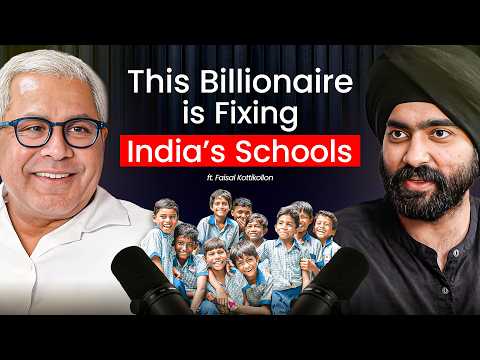
Indian Silicon Valley by Jivraj Singh Sachar's He Sold a $400M Company to Fix India’s Schools & Healthcare – Faizal Kottikollon (KEF Holdings): skim's analysis identifies 11 key moments, with 2 potential conflicts of interest flagged. Faizal Kottikollon, founder of KEF Holdings, details how a $400 million industrial exit in Dubai led him to pioneer prefabricated social infrastructure in India.
Category: Business. Format: Interview. YouTube video analyzed by skim.
skim AI Analysis
Credibility assessment: Firsthand Founder Account. Faizal Kottikollon provides detailed, firsthand operational history regarding his corporate exits, prefab manufacturing plants, and Kerala government school partnerships. However, his extraordinary claims about Ayurveda and RNA-based goat-meat poultices regenerating dead spinal nerves rely on personal anecdote rather than peer-reviewed clinical data.
Bias assessment: Reverent Founder Showcase. Host Jivraj acts as an enthusiastic admirer rather than a critical interviewer, praising Faizal Kottikollon's ventures while living on-site at his wellness sanctuary. Furthermore, the conversation promotes Faizal's commercial healthcare and wellness brands without probing their financial or medical limitations.
Originality: 84% — Rare Industrial Philanthropy. The discussion offers a rare, granular look at applying heavy industrial prefabrication to public school reform and tier-three hospital construction in India, moving well beyond standard software entrepreneurship tropes.
Depth: 68% — Practical Systems Thinking. Faizal Kottikollon breaks down supply-chain integration, gap analysis with the Indian Institute of Management, and hospital revenue-per-bed economics, though the back half shifts toward broad spiritual philosophy and unexamined medical assertions.
Key Points (11)
1. Faizal Kottikollon's Ethos of Custodianship
Timestamp: 00:02:11 to 00:06:22
Faizal Kottikollon explains that his father, a prominent Kerala industrialist, raised him to view wealth as a temporary responsibility rather than personal property. Working in his father's shop from age 13 alongside happy, modest workers shaped his belief that business exists to serve the broader ecosystem. This spiritual foundation guided his leadership across decades of industrial building.
Significance (Medium): Frames large-scale capital allocation around stewardship rather than personal accumulation, setting the philosophical baseline for his later social ventures.
Sources in support: Faizal Kottikollon (Founder of KEF Holdings), YouTube: Indian Silicon Valley by Jivraj Singh Sachar
2. Early Athletics and Workplace Discipline
Timestamp: 00:07:27 to 00:11:12
Growing up with a weightlifting-champion father who enforced 5:00 a.m. workouts kept Faizal Kottikollon grounded through engineering school at Manipal in 1982. Later, arriving first every morning at a New Jersey furnace manufacturer caught the eye of billionaire chairman Henry Rowan and accelerated his career. He concludes that visible self-discipline consistently unlocks mentorship and rapid promotion for young professionals.
Significance (Medium): Demonstrates how compounded daily habits and punctuality create career leverage long before an entrepreneur launches their own company.
Sources in support: Faizal Kottikollon (Founder of KEF Holdings)
3. Pioneering the First Green Foundry
Timestamp: 00:11:15 to 00:14:17
After starting Emirates Techno Casting in the UAE, Faizal Kottikollon spent nine struggling years seeking a way to clean up highly polluting red-category foundry work. Meeting an Austrian engineer in 2005 led him to deploy the first vacuum furnace technology for large oil-and-gas castings outside the Western world. Reinvesting his first $5 million profit in 2006 into an employee community center propelled the business forward.
Significance (High): Shows how solving environmental bottlenecks in heavy industry while investing early profits into worker welfare can differentiate a manufacturing startup.
Sources in support: Faizal Kottikollon (Founder of KEF Holdings)
4. $400M Unicorn Exit Left an Emotional Void
Timestamp: 00:15:10 to 00:20:12
Faizal Kottikollon's mandatory 70,000-square-foot worker community center attracted UAE rulers, countered Western media critiques of Gulf labor, and drew buyouts from Dubai Holding, Tyco, and Pentair. Yet after banking $400 million in 2012 and leasing a private jet for six months, he and his wife felt bored and unfulfilled. Realizing money cannot buy happiness pushed him to return to India to build schools and hospitals.
Significance (High): Challenges the conventional startup narrative that a九-figure liquidity event is the ultimate finish line, highlighting the psychological vacuum after an exit.
Sources in support: Faizal Kottikollon (Founder of KEF Holdings), YouTube: Indian Silicon Valley by Jivraj Singh Sachar
5. Daily Iyengar Yoga Sharpens Decision Clarity
Timestamp: 00:21:00 to 00:23:14
Addressing young people seeking direction, Faizal Kottikollon attributes his clarity across three major business exits to over 30 years of daily morning yoga and breathwork. Walking in the sun at 5:30 a.m. followed by 90 minutes of Iyengar yoga clears mental stress and removes judgment toward others. He urges listeners to commit to a 10-day daily practice to experience internal balance firsthand.
Significance (Low): Offers a concrete, non-mystical daily regimen for founders and young professionals struggling with executive stress and decision fatigue.
Sources in support: Faizal Kottikollon (Founder of KEF Holdings), YouTube: Indian Silicon Valley by Jivraj Singh Sachar
6. Building the World's Largest Prefab Park
Timestamp: 00:23:44 to 00:29:38
An Indian Institute of Management gap analysis of a Calicut girls' school revealed that government teachers were well-paid and qualified, but crumbling facilities—like having only 8 working toilets out of 91 for 2,000 students—drove children away. Inspired by Finland, Faizal Kottikollon invested 450 crores in 2014 to build nine automated prefab factories on 42 acres in Krishnagiri. Delivering 23 million square feet in four years led to a major merger with SoftBank-backed Katerra.
Significance (High): Identifies physical infrastructure—not teacher quality—as a primary bottleneck in Indian public education and proves industrial prefabrication can solve it at scale.
Sources in support: Faizal Kottikollon (Founder of KEF Holdings), YouTube: Indian Silicon Valley by Jivraj Singh Sachar
7. Faizal Kottikollon Claims Ayurveda Healed His Spine
Timestamp: 00:30:30 to 00:37:53
After COVID-19 exposed the limits of reactive medicine, Faizal Kottikollon developed severe C4-C6 spinal degeneration in 2022 from years of yoga headstands. Avoiding risky surgery recommended in Singapore and at his own Maitra Hospital, he consulted 99-year-old Ayurvedic physician P. K. Warrier and underwent three 21-day Panchakarma retreats using herbal goat-meat poultices. He claims follow-up MRIs showed dead nerve regeneration, inspiring him to build the Tula clinical wellness sanctuary.
Significance (Medium): Explains the personal medical catalyst behind the Tula sanctuary, though the extraordinary claim of regenerating dead spinal nerves rests on personal testimony.
Sources in support: Faizal Kottikollon (Founder of KEF Holdings), YouTube: Indian Silicon Valley by Jivraj Singh Sachar
8. Scaling the Nadakkavu Model to 977 Schools
Timestamp: 00:39:05 to 00:48:21
With 250 million Indian children in government schools in 2012, Faizal Kottikollon partnered with Calicut MLA Pradeep Kumar under the PRISM initiative, flying him to Dubai to tour international schools. After Kerala amended three government orders to allow private foundation funding, his team rebuilt the 3.5-acre Nadakkavu school in 90 days during summer break and trained 82 teachers at IIM Calicut. The Kerala government subsequently invested over 3,000 crores to replicate this model across 977 public schools.
Significance (High): Provides a replicable blueprint for public-private philanthropy: prove a rapid turnaround on one flagship site, make elected officials the public face, and let state budgets scale it.
Sources in support: Faizal Kottikollon (Founder of KEF Holdings), YouTube: Indian Silicon Valley by Jivraj Singh Sachar
9. Maitra Hospital's Modular Design and KKR Deal
Timestamp: 00:49:20 to 00:53:56
Inspired by a 2012 visit to the Cleveland Clinic, Faizal Kottikollon set out to fix India's sickening hospital environments by designing Maitra Hospital as a welcoming 'hospitel.' Assembled in Calicut like Lego blocks from factory-made modular ICUs, bathrooms, and MEP systems built to last 100 years, Maitra operated for eight years before securing a strategic partnership with KKR. Together they plan to replicate the model across major Indian cities over the next decade.
Significance (High): Validates that heavy capital expenditure on prefabricated, hospitality-grade hospital infrastructure can attract top-tier global private equity for national expansion.
Sources in support: Faizal Kottikollon (Founder of KEF Holdings), YouTube: Indian Silicon Valley by Jivraj Singh Sachar
10. Why Tier-3 Cities Outperform in Healthcare
Timestamp: 00:54:32 to 00:58:14
Faizal Kottikollon urges young Indian entrepreneurs to look beyond laptop software and build hard social infrastructure in tier-two and tier-three cities. Operating in tier-three Calicut, Maitra Hospital handles complex heart, liver, and kidney transplants from around the world and generated 72,000 rupees in average revenue per occupied bed last month—the highest in South India. He offers to share his prefabrication and water-based radiant cooling technologies with builders closing India's infrastructure gap with China.
Significance (High): Refutes the assumption that premium medical care requires a metro location, backing tier-three viability with concrete revenue-per-bed metrics.
Sources in support: Faizal Kottikollon (Founder of KEF Holdings), YouTube: Indian Silicon Valley by Jivraj Singh Sachar
11. Expanding Wellness via Tula and the Via Brand
Timestamp: 00:58:59 to 01:02:59
Criticizing the pharmaceutical industry for profiting off symptomatic treatments, Faizal Kottikollon positions Tula as a 1,000-crore sustainable sanctuary designed to shift global thought leaders from illness to preventive wellness. To make this integrative approach accessible to everyday citizens, he recently launched a second brand called Via that will open rehabilitation and wellness centers alongside hospitals across Indian cities. He concludes that India's global rise should be defined by exporting Vedanta and spiritual wellness rather than military dominance.
Significance (Medium): Outlines the two-tiered business strategy for his wellness thesis: an ultra-exclusive Rs 1,000-crore flagship for elites paired with hospital-adjacent Via clinics for the broader public.
Sources in support: Faizal Kottikollon (Founder of KEF Holdings)
This analysis was generated by skim (skim.plus), an AI-powered content analysis platform by Credible AI. Scores and classifications represent the platform's AI-generated assessment and should be considered alongside other sources.