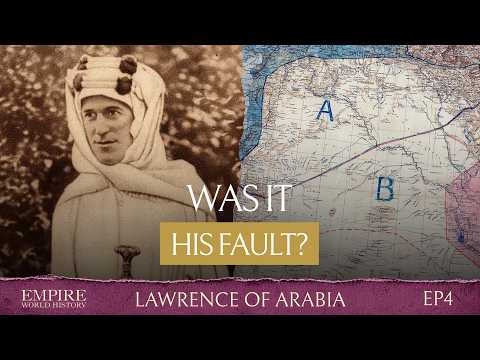
Empire • World History's Lawrence of Arabia: Palestine, Iraq & The Motorcycle Crash: skim's analysis identifies 10 key moments. William Dalrymple and biographer Scott Anderson examine T.
Category: Education. Format: Interview. YouTube video analyzed by skim.
skim AI Analysis
Credibility assessment: Scholarly Historical Analysis. Historian William Dalrymple and biographer Scott Anderson ground their discussion in documented treaties, letters, and memoirs from the 1919 Paris Peace Conference and the 1921 Cairo Conference, clearly distinguishing primary historical events from their own psychological interpretations of T.E. Lawrence.
Bias assessment: Anti-Imperial Critique. Both speakers evaluate post-WWI British and French diplomacy as a treacherous betrayal of Arab self-determination, while debating whether T.E. Lawrence was a broken victim of guilt or an irresponsible romantic who failed his allies at the negotiating table.
Originality: 82% — Engaging Historiographical Debate. Rather than repeating the heroic Lawrence of Arabia myth, William Dalrymple presses Scott Anderson on Lawrence's diplomatic unpreparedness at Versailles against the organized Zionist delegation, generating a sharp debate over agency, trauma, and modern Middle Eastern borders.
Depth: 88% — Deep Geopolitical Context. The conversation connects 1919 diplomatic mechanics, such as water-rights memoranda and Mosul oil pipeline routing, directly to the creation of Iraq and Transjordan, Lawrence's postwar psychological collapse, and 21st-century regional instability.
Key Points (10)
1. Faisal-Weizmann Pact and Arab Resentment
Timestamp: 00:00:00 to 00:02:32
Scott Anderson explains that T.E. Lawrence arranged the Faisal-Weizmann agreement to allow Jewish immigration into Palestine only if Britain honored its broader independence promises to the Arabs. Because those promises failed, educated Arabs view the pact and the 1917 Balfour Declaration as a betrayal, leaving Lawrence resented in the region.
Significance (Medium): Frames the 1919 Faisal-Weizmann pact not as unconditional Arab consent to Zionism, but as a contingent deal voided by British imperial broken promises.
Sources in support: Scott Anderson (Author of Lawrence in Arabia), William Dalrymple (Host, Empire Podcast)
2. Britain Bars Lawrence from Paris Talks
Timestamp: 00:02:32 to 00:07:07
At the 1919 Paris Peace Conference, Allied powers treated the Arab delegation as an exotic curiosity before ordering T.E. Lawrence back to London barracks to isolate Faisal without his chief advocate. Meanwhile, an American publicist's multimedia stage show romanticized Lawrence for a war-weary British public seeking an alternative to the grim Western Front.
Significance (High): Shows how Britain neutralized its own famous liaison officer at Versailles while popular media simultaneously transformed him into a romantic imperial celebrity.
Sources in support: Scott Anderson (Author of Lawrence in Arabia), William Dalrymple (Host, Empire Podcast)
3. Dalrymple Faults Unprepared Arab Delegation
Timestamp: 00:07:07 to 00:11:41
William Dalrymple argues that T.E. Lawrence and Faisal bear partial responsibility for the Versailles disaster because they arrived late without maps or formal negotiating texts, whereas Chaim Weizmann's Zionist delegation spent six weeks lobbying leaders with detailed water and agricultural surveys. Scott Anderson counters that Britain restricted Lawrence's movements and dismissed Faisal as an outsider from the Hejaz.
Significance (High): Challenges the heroic narrative of Lawrence by contrasting his improvisational style with the disciplined, technocratic preparation of the Zionist delegation in Paris.
Sources in support: William Dalrymple (Host, Empire Podcast), Scott Anderson (Author of Lawrence in Arabia)
4. Woodrow Wilson Yields and Mosul Oil Shapes Jordan
Timestamp: 00:12:46 to 00:16:27
Scott Anderson notes that Woodrow Wilson quickly abandoned his rhetoric of self-determination at Versailles to align with British and French imperial designs. Furthermore, the wartime discovery of oil in Mosul prompted Britain to carve Jordan with an eastern corridor reaching Iraq so they could run a pipeline to the Mediterranean, while France claimed Greater Syria.
Significance (High): Explains the puzzling geographic panhandle of modern Jordan as a direct byproduct of British naval oil strategy and Mediterranean pipeline planning after World War I.
Sources in support: Scott Anderson (Author of Lawrence in Arabia), William Dalrymple (Host, Empire Podcast)
5. Trauma vs Chivalry in Lawrence's Diplomatic Failure
Timestamp: 00:16:58 to 00:23:21
William Dalrymple criticizes T.E. Lawrence for failing to bring the McMahon-Hussein correspondence to Versailles and relying on 19th-century notions of gentlemanly honor against a well-organized Zionist movement. Scott Anderson replies that Lawrence was psychologically broken by his wartime atrocities near Damascus, leading him later to enlist as a private to avoid all responsibility.
Significance (High): Presents the central biographical clash over Lawrence: whether his postwar passivity stemmed from debilitating war trauma or amateurish aristocratic vanity.
Sources in support: Scott Anderson (Author of Lawrence in Arabia)
Sources against: William Dalrymple (Host, Empire Podcast)
6. 1921 Cairo Conference Creates Iraq and Transjordan
Timestamp: 00:23:22 to 00:30:13
Following the 1920 San Remo conference, French troops overthrew Faisal in Damascus and anti-colonial revolts erupted across the Arab world. At the March 1921 Cairo Conference, Colonial Secretary Winston Churchill and T.E. Lawrence redrew the map by installing Faisal as King of Iraq and his brother Abdullah over the newly invented territory of Transjordan, after which Lawrence falsely claimed Britain had fulfilled its debt to the Arabs.
Significance (High): Details the exactMarch 1921 hotel meeting where Britain invented the modern states of Iraq and Jordan to pacify Arab revolts with Hashemite figureheads.
Sources in support: Scott Anderson (Author of Lawrence in Arabia), William Dalrymple (Host, Empire Podcast)
7. Writing Seven Pillars of Wisdom at Oxford
Timestamp: 00:30:13 to 00:34:32
Retreating to All Souls College, Oxford, T.E. Lawrence wrote Seven Pillars of Wisdom, rewriting the entire book after losing the first manuscript at Reading Station and printing only 12 initial copies. William Dalrymple praises it as one of the great literary works of the early 20th century, while Scott Anderson finds it brilliant in spots but turgid where Lawrence pasted verbatim prewar field reports.
Significance (Medium): Reverses the speakers' earlier roles, with critic William Dalrymple championing Lawrence's prose style against biographer Scott Anderson's mixed literary verdict.
Sources in support: William Dalrymple (Host, Empire Podcast), Scott Anderson (Author of Lawrence in Arabia)
8. Lowell Thomas Show and Retreating into the Ranks
Timestamp: 00:34:32 to 00:41:11
American journalist Lowell Thomas turned T.E. Lawrence into a celebrity with a London stage show seen by four million people, which Lawrence secretly attended while professing embarrassment. Seeking escape, Lawrence legally changed his name, served two years as a private at the Khyber Pass in India, and spent 15 years in the Royal Air Force under the name Shaw testing high-speed rescue boats and living at Clouds Hill.
Significance (Medium): Traces Lawrence's extreme reaction to four million people viewing his stage legend: stripping off his colonel's rank to live for 15 years as an enlisted mechanic.
Sources in support: Scott Anderson (Author of Lawrence in Arabia), William Dalrymple (Host, Empire Podcast)
9. Refusing the King's Knighthood and Final Crash
Timestamp: 00:41:11 to 00:46:45
Scott Anderson recounts how T.E. Lawrence shocked Buckingham Palace in late 1918 by refusing a knighthood mid-investiture to protest Britain's betrayal of the Arabs. Seventeen years later, a month after retiring from the Royal Air Force in deep depression, Lawrence died at age 46 following a May 13, 1935 motorcycle crash in Dorset after swerving to avoid two boys on bicycles.
Significance (Medium): Connects Lawrence's unprecedented 1918 royal protest to his melancholic 1935 death, dismissing murder conspiracies while acknowledging his severe post-traumatic depression.
Sources in support: Scott Anderson (Author of Lawrence in Arabia), William Dalrymple (Host, Empire Podcast)
10. Artificial States and Modern Middle East Conflicts
Timestamp: 00:46:45 to 00:52:28
William Dalrymple and Scott Anderson assess the century-long fallout of Britain's contradictory WWI promises in light of ongoing wars in Gaza, Syria, and Iraq. Anderson observes that the artificial states carved up in 1919 and 1921 fractured bloodily after the 2003 Iraq invasion and 2011 Arab Spring, whereas Hashemite Jordan unexpectedly survived as a regional island of stability.
Significance (High): Draws a direct line from the 1919-1921 Anglo-French border carving to the post-2011 collapse of Syria and Iraq alongside the contrasting stability of Hashemite Jordan.
Sources in support: Scott Anderson (Author of Lawrence in Arabia), William Dalrymple (Host, Empire Podcast)
This analysis was generated by skim (skim.plus), an AI-powered content analysis platform by Credible AI. Scores and classifications represent the platform's AI-generated assessment and should be considered alongside other sources.