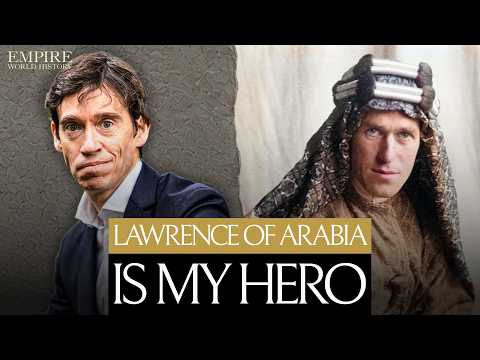
Empire • World History's Rory Stewart Unpacks Lawrence of Arabia’s Unusual Character: skim's analysis identifies 12 key moments, with 2 potential conflicts of interest flagged. Rory Stewart joins Anita Anand and William Dalrymple to debate T.
Category: Education. Format: Interview. YouTube video analyzed by skim.
skim AI Analysis
Credibility assessment: Historically Grounded Debate. Rory Stewart, William Dalrymple, and Anita Anand ground their debate in primary sources, including T.E. Lawrence's letters to The Times, Seven Pillars of Wisdom, and biographies by Suleiman Mousa and John Mack. Stewart also brings firsthand administrative experience from Iraq and Afghanistan.
Bias assessment: Empathetic Anti-Imperialism. While all three participants strongly condemn British imperial administration and modern military interventions, Stewart defends T.E. Lawrence from austere moral judgment by emphasizing the compromises of political and military life, whereas Dalrymple presses a harsher critique of Lawrence's complicity.
Originality: 86% — Practitioner-Historian Clash. Pairing an ex-diplomat who served as a deputy governor in occupied Iraq with two historians yields fresh friction. Linking Lawrence's 1920s journalism to modern counterinsurgency doctrine, Alexander Burnes, and contemporary Gaza avoids standard biographical cliches.
Depth: 88% — Multi-Layered Historical Probe. The discussion moves beyond desert-warrior mythology to examine bureaucratic infighting between the India Office and Arab Bureau, structural asymmetries at the Versailles Peace Conference, counterinsurgency theory under David Petraeus, and the limits of historical causation.
Key Points (12)
1. Rory Stewart on Lawrence's Guilt and Nerdiness
Timestamp: 00:00:00 to 00:04:17
Rory Stewart admits to admiring T.E. Lawrence as the apotheosis of an awkward, geeky soldier rather than a conventional warrior. He argues that Seven Pillars of Wisdom is fundamentally a book about guilt and betrayal that left Lawrence psychologically broken. Stewart concludes that modern historians who claim to expose Lawrence's treachery miss that Lawrence openly documented the cost of his own betrayal from the opening pages.
Significance (Medium): Framing Seven Pillars of Wisdom as a self-aware confession of betrayal shifts the historical debate from uncovering hidden deceit to evaluating how imperial officers cope with contradictory loyalties.
Sources in support: Rory Stewart (Author, ex-diplomat, ex-politician, and co-host of The Rest Is Politics)
Neutral sources: Anita Anand (Co-host of Empire podcast), William Dalrymple (Historian and co-host of Empire podcast)
2. Lawrence's 1920s Letters Condemning Iraq Rule
Timestamp: 00:05:23 to 00:09:03
Drawing on his experience as deputy governor in southern Iraq, Stewart highlights Lawrence's 1920s newspaper writings attacking British administrators like Sir Arnold Wilson. He notes that although Lawrence romanticized the Bedouin during the war, his postwar journalism recognized that Middle Eastern autonomy would belong to anti-colonial urban demagogues. Reading from a letter to The Times, Anita Anand underscores how Lawrence warned that England had been tricked into a bloody trap in Iraq.
Significance (High): Surfacing Lawrence's 1920s anti-imperial journalism complicates his image as an arch-imperialist and shows how early insiders diagnosed the structural failure of Mesopotamian occupation.
Sources in support: Rory Stewart (Author, ex-diplomat, ex-politician, and co-host of The Rest Is Politics), Anita Anand (Co-host of Empire podcast), William Dalrymple (Historian and co-host of Empire podcast)
3. Whitehall Smears Against Dissenting Insiders
Timestamp: 00:09:03 to 00:11:24
Stewart contends that much of the narrative dismissing Lawrence's Arabic skills and wartime importance originated as friendly fire from the India Office and Foreign Office once Lawrence began criticizing British Middle East policy. He compares this to his own experience criticizing the intervention in Afghanistan, when former Foreign Office colleagues suddenly questioned his Dari fluency and years on the ground. The exchange shows how bureaucracies discredit dissenting practitioners by attacking their credentials.
Significance (Medium): Tracing doubts about Lawrence's competence back to rival Whitehall departments reveals how state bureaucracies manufacture credentialist attacks to neutralize internal whistleblowers.
Sources in support: Rory Stewart (Author, ex-diplomat, ex-politician, and co-host of The Rest Is Politics)
Neutral sources: Anita Anand (Co-host of Empire podcast)
4. Why US Soldiers Misread Lawrence's Persona
Timestamp: 00:11:24 to 00:16:47
Stewart explains that US military circles around General David Petraeus venerated Lawrence because theorists of insurgency and small-unit railway sabotage are rare in regular armies. However, he and William Dalrymple point out the irony that macho American soldiers and figures like Pete Hegseth could not be more different from Lawrence, who was an Oxford medievalist, brass-rubbing enthusiast, and friend of E.M. Forster and George Bernard Shaw. Stewart concludes that British military aristocrats treated the middle-class Lawrence as an eccentric mascot before bureaucracies pushed him aside after the war.
Significance (Medium): Exposing the gulf between Lawrence's bookish Oxford sensibility and modern American military culture shows how counterinsurgency doctrine strips historical texts from the temperament of their authors.
Sources in support: Rory Stewart (Author, ex-diplomat, ex-politician, and co-host of The Rest Is Politics), Anita Anand (Co-host of Empire podcast), William Dalrymple (Historian and co-host of Empire podcast)
5. Did British Rule Prove Worse Than the Ottomans?
Timestamp: 00:16:47 to 00:20:20
William Dalrymple asks whether Lawrence ever admitted that replacing the Ottoman Empire with British colonial rule left Arabs worse off. Stewart replies that facing that possibility directly was likely too unbearable for Lawrence, much like coalition officials struggling to admit post-2003 Iraq might be worse than Saddam Hussein, and that Lawrence tempered his public criticism to keep policymakers like Winston Churchill on side. Yet Stewart argues Lawrence's nervous breakdown and refusal to see Faisal in London prove he privately recognized the scale of the betrayal.
Significance (High): Comparing post-Ottoman Iraq to post-Saddam Iraq illustrates the psychological block that prevents liberating powers from acknowledging when regime change produces a worse order.
Sources in support: Rory Stewart (Author, ex-diplomat, ex-politician, and co-host of The Rest Is Politics), William Dalrymple (Historian and co-host of Empire podcast)
6. Parallels With Alexander Burnes and 2003 Iraq
Timestamp: 00:20:20 to 00:24:01
Prompted by Anita Anand to connect 19th-century explorer Alexander Burnes, Lawrence, and himself, Stewart reflects on governing a million Iraqis in his late twenties under the Coalition Provisional Authority. He identifies two ways to view figures like Burnes and Lawrence: either as complicit agents in an evil imperial project, or as culturally curious outliers who were far less racist and ignorant than fellow officers. Anand counters by asking whether liking local people matters at all if an officer still ends up betraying them.
Significance (High): Anand's challenge pierces the liberal imperialist defense, asking whether cultural sympathy and personal conscience carry any moral weight when the political outcome is still subjugation.
Sources in support: Rory Stewart (Author, ex-diplomat, ex-politician, and co-host of The Rest Is Politics)
Sources against: Anita Anand (Co-host of Empire podcast)
Neutral sources: William Dalrymple (Historian and co-host of Empire podcast)
7. Dalrymple Challenges Lawrence's Sykes-Picot Lie
Timestamp: 00:24:01 to 00:27:13
William Dalrymple challenges Stewart's description of Lawrence's integrity, pointing out that Lawrence knew about the Sykes-Picot agreement from the start and urged Arabs to fight on a lie. Stewart agrees Lawrence admitted this, explaining Lawrence gambled that capturing Damascus and installing the Hashemite family would give the Arabs leverage to outmaneuver Britain and France. Stewart weighs this double game against the immediate battlefield loyalty of a soldier risking his life for comrades in a small unit.
Significance (High): Examining Lawrence's hope that seizing Damascus could override Sykes-Picot highlights the perilous delusion of field officers who think tactical facts on the ground can defeat great-power treaties.
Sources in support: Rory Stewart (Author, ex-diplomat, ex-politician, and co-host of The Rest Is Politics)
Sources against: William Dalrymple (Historian and co-host of Empire podcast)
8. Arab Assessments of Lawrence's Wartime Role
Timestamp: 00:27:13 to 00:29:20
Anita Anand cites Arab historian Suleiman Mousa, who interviewed Arab Revolt veterans and concluded Lawrence inflated his own importance when he was merely one of several liaison officers. Stewart points to biographer John Mack's 1963 interviews and his own conversations with veterans' descendants, noting they viewed the revolt as Hashemite-led under Faisal with Lawrence serving as Faisal's lieutenant. Nevertheless, Stewart argues Arab fighters respected Lawrence's courage, logistics, and care for their families far more than any other British officer.
Significance (Medium): Contrasting Suleiman Mousa's skepticism with John Mack's interviews calibrates Lawrence's true wartime stature: neither the sole architect of Western legend nor an irrelevant bystander.
Sources in support: Rory Stewart (Author, ex-diplomat, ex-politician, and co-host of The Rest Is Politics)
Sources against: Anita Anand (Co-host of Empire podcast)
Neutral sources: William Dalrymple (Historian and co-host of Empire podcast)
9. Why Faisal and Lawrence Lost Out at Versailles
Timestamp: 00:29:20 to 00:34:41
William Dalrymple criticizes Lawrence and Faisal's preparation at the Versailles Peace Conference as a fiasco, contrasting their lack of maps and McMahon letters with Chaim Weizmann's Zionist delegation, which arrived weeks early with river maps, surveys, and close ties to David Lloyd George and Arthur Balfour. Stewart counters that blaming Lawrence ignores massive structural asymmetries, noting Weizmann had lived in Britain since 1904 with a 15-year political network while Faisal had no staff and faced active hostility from the India Office. They also link this hostility to Sir Henry McMahon's background among Anglo-Indian political officers who disdained young mavericks like Lawrence.
Significance (High): Comparing Chaim Weizmann's entrenched British networks with Faisal's isolated delegation explains how structural lobbying power, rather than personal homework, decided the post-1918 Middle East.
Sources in support: Rory Stewart (Author, ex-diplomat, ex-politician, and co-host of The Rest Is Politics)
Sources against: William Dalrymple (Historian and co-host of Empire podcast)
Neutral sources: Anita Anand (Co-host of Empire podcast)
10. Anand Critiques Lawrence's Arab Bulletin Advice
Timestamp: 00:34:41 to 00:36:45
Anita Anand examines Lawrence's guidance in the Arab Bulletin advising British officers to behave like an Edwardian wife by never giving direct orders, agreeing with sheikhs, and steering Arabs gently so they do things imperfectly themselves. She expresses distaste for this advice, calling it a patronizing trick to make Arabs compliant. Stewart acknowledges the paternalism but argues Lawrence viewed indirect steering, much like parenting teenagers, as the only way to transition toward Arab self-reliance rather than issuing futile military commands.
Significance (Medium): Dissecting Lawrence's Twenty-Seven Articles exposes the paternalistic core of indirect colonial rule, where respecting local autonomy doubles as a technique of psychological management.
Sources in support: Anita Anand (Co-host of Empire podcast)
Sources against: Rory Stewart (Author, ex-diplomat, ex-politician, and co-host of The Rest Is Politics)
11. Stewart Demands Empathy for Political Compromise
Timestamp: 00:36:45 to 00:39:22
William Dalrymple asks why Lawrence enlisted in the RAF while it bombed Iraqi villages and publicly claimed in 1921 that Britain had fulfilled its promises by giving Faisal part of Iraq and Abdullah Jordan. Stewart explains that Lawrence was spinning an incremental political compromise after inheriting a disastrous baseline, comparing it to his own time as a UK minister claiming victory over minor improvements in prison violence. He argues that critics who have never served in politics or the military judge Lawrence by austere moral standards they could never meet themselves.
Significance (High): Stewart's defense of incremental political spin challenges armchair historians to distinguish between moral purity outside power and the compromised bargains available to officials inside government.
Sources in support: Rory Stewart (Author, ex-diplomat, ex-politician, and co-host of The Rest Is Politics)
Sources against: William Dalrymple (Historian and co-host of Empire podcast)
12. Stewart Rejects Blaming Lawrence for Modern Gaza
Timestamp: 00:39:22 to 00:43:00
Asked by Anita Anand whether the destruction of Gaza makes him judge Lawrence more harshly for helping settle the post-WWI mandate, Stewart rejects blaming a British officer from 110 years ago as absurd and dangerous. While acknowledging Dalrymple's point that Lawrence approved of Zionist immigration into Palestine and belongs to the historical chain leading to Israel's creation, Stewart insists moral responsibility for Gaza rests squarely with Benjamin Netanyahu's government. He concludes that nothing Lawrence envisioned in 1922 excused or inevitably produced AI-enabled mass killing of 70,000 people and 20,000 children in Gaza.
Significance (High): Separating the 1920s historical origins of the Palestine Mandate from contemporary war crimes prevents historical determinism from absolving modern political leaders of direct moral agency.
Sources in support: Rory Stewart (Author, ex-diplomat, ex-politician, and co-host of The Rest Is Politics)
Sources against: William Dalrymple (Historian and co-host of Empire podcast)
Neutral sources: Anita Anand (Co-host of Empire podcast)
This analysis was generated by skim (skim.plus), an AI-powered content analysis platform by Credible AI. Scores and classifications represent the platform's AI-generated assessment and should be considered alongside other sources.