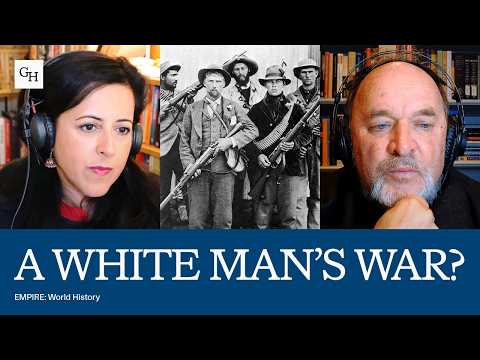
The Boer War: How The British Empire Was Almost Defeated
Empire • World History
Summary
South African historian Bill Nasson joins Anita Anand and William Dalrymple to examine the Second Anglo-Boer War of 1899 to 1902 from its seventeenth-century Dutch roots and the Great Trek through the discovery of Witwatersrand gold and the botched 1895 Jameson Raid. When British High Commissioner Alfred Milner forced a breakdown in talks with Transvaal President Paul Kruger, 60,000 Boer commandos struck first, besieging Mafeking, Kimberley, and Ladysmith and inflicting humiliating defeats during Black Week and at Spion Kop. Britain responded by pouring in nearly 200,000 troops under Frederick Roberts and Lord Kitchener, who countered guerrilla leaders Louis Botha, Jan Smuts, and Christiaan de Wet by burning 30,000 farms and interning Boer families and Black farmworkers in segregated concentration camps.
Exposed by campaigner Emily Hobhouse and pressured by rural African uprisings like the 1902 Zulu raid at Holkrans, the war ended with a 1902 peace that reconciled British and Boer interests by sacrificing Black voting rights under Clause 8. Within eight years, defeated generals Botha and Smuts led the 1910 Union of South Africa on a segregationist blueprint that led to Apartheid, while betrayed Black and Indian loyalists like Mafeking diarist Sol Plaatje and stretcher-bearer Mahatma Gandhi went on to help found the ANC and launch Satyagraha.
How time-sensitive the topic is: Retrospective
By the numbers
21,000 signatures: Uitlander petition sent to Queen Victoria following the shooting of Tom Edgar that Alfred Milner used to push for intervention. (Mentioned at 29:23)
60,000 Boer commandos: Approximate strength of mobilized Boer commandos compared to 20,000 British troops at the start of the war in October 1899. (Mentioned at 36:07)
1,100 Indian stretcher-bearers: 300 free Indians and 800 indentured sugar workers organized by Mahatma Gandhi in the Natal Indian Ambulance Corps. (Mentioned at 1:09:20)
217 days: Duration of the Siege of Mafeking under Colonel Robert Baden-Powell. (Mentioned at 1:12:00)
200,000 British troops: Nearly 180,000 to 200,000 troops poured into South Africa by Britain to turn the war around, outnumbering the white population of both Boer republics. (Mentioned at 1:20:09)
30,000 farms burned: Total number of Boer farms burned by British forces under their scorched-earth campaign. (Mentioned at 1:34:52)
3,156 deaths: Number of people who died in British concentration camps during October 1901, the worst single month of camp mortality. (Mentioned at 1:41:39)
56 Boers killed: Boer commandos speared to death by a Zulu impi during a punitive night raid at Holkrans in 1902. (Mentioned at 1:52:18)
120,000 African auxiliaries: Estimated number of Black South Africans who served with British forces during the war, alongside about 14,000 serving Boer commandos. (Mentioned at 1:57:00)
3,000 Indians: Crowd gathered by Mahatma Gandhi at the Empire Theatre in Johannesburg in September 1906 to pledge Satyagraha resistance against pass laws. (Mentioned at 2:26:53)
Questions this video answers
What caused the Second Anglo-Boer War in 1899?
The discovery of the world's largest gold deposit on the Witwatersrand shifted South Africa's economic power from British coastal colonies to Paul Kruger's independent Transvaal republic. Combined with German financial ties to Pretoria and British High Commissioner Alfred Milner's determination to assert imperial supremacy using Uitlander voting grievances as a pretext, talks collapsed in 1899. This matters because the war was fundamentally a struggle for regional economic and imperial dominance rather than simple franchise reform.
Bill Nasson, 8:04 to 15:42
From this keypoint: First Boer War Humiliation and Witwatersrand Gold
Why did the Dutch settlers originally go on the Great Trek in South Africa?
After Britain permanently took the Cape Colony during the Napoleonic Wars, it imposed English courts and laws and abolished slavery across the British Empire in the 1830s. Resentful of losing their slaves and being excluded from civil service jobs, marginal and land-hungry Dutch colonists trekked into the interior to found the Transvaal and Orange Free State. Their inland expansion displaced indigenous African societies and set up a long-term rivalry with the British crown.
Bill Nasson, 1:22 to 8:04
From this keypoint: Bill Nasson Traces Dutch Settlement and Great Trek
Why did the British set up concentration camps during the Boer War?
When younger Boer leaders launched a mobile guerrilla war in 1900, British commanders Frederick Roberts and Lord Kitchener burned 30,000 farms to cut off the commandos' food and shelter. While British propaganda claimed the camps were humanitarian refugee shelters, Kitchener explicitly used the internment of Boer women and children—as well as segregated camps for Black farmworkers—to pressure fighting husbands into surrendering. Callous military mismanagement and unsanitary conditions caused rampant disease that killed thousands of inmates, including 3,156 in October 1901 alone.
Bill Nasson, 1:33:11 to 1:42:20
From this keypoint: Kitchener's Scorched Earth and Concentration Camps
What role did Emily Hobhouse play in the Boer War concentration camps?
Cornish humanitarian Emily Hobhouse traveled to South Africa in December 1900 after hearing missionary reports of dying children and inspected the Bloemfontein camp in person. She documented starving families crammed into suffocating bell tents without soap or water, bringing photographs and testimony back to Britain that sparked parliamentary outrage over 'methods of barbarism.' Her investigation turned British public opinion and earned her permanent recognition in South Africa.
Anita Anand, 1:42:20 to 1:50:17
From this keypoint: Emily Hobhouse Exposes British Camp Horrors
What did Mahatma Gandhi do during and after the Boer War in South Africa?
During the war, Gandhi organized 1,100 Indian volunteers into the Natal Indian Ambulance Corps to carry wounded British soldiers at battles like Spion Kop, believing imperial loyalty would win civil rights for Indians. When postwar authorities instead enforced humiliating pass laws and police raids on Indian homes, Gandhi gathered 3,000 Indians at Johannesburg's Empire Theatre in September 1906 to launch his first Satyagraha campaign against Jan Smuts. This struggle forged the nonviolent resistance philosophy that later challenged the British Raj in India.
Anita Anand, 2:22:58 to 2:31:29
From this keypoint: World War I Lessons and Gandhi's Birth of Satyagraha
What happened to Winston Churchill during the Boer War?
Arriving in South Africa as a 24-year-old war correspondent for the Morning Post, Churchill was captured by Boer commandos on November 15, 1899 when an armored train was ambushed near Estcourt. He escaped captivity to Durban, cabled a prescient warning that Britain needed 250,000 troops, and served as a uniformed courier during the bloody defeat at Spion Kop. Although Bill Nasson notes Churchill's importance to the Boers was mythologized, the media coverage of his escape launched his career in Parliament.
Bill Nasson, 49:40 to 56:18
From this keypoint: Baden-Powell and Young Churchill Build War Myths
Why did the Boers fail to capture the port of Durban in 1899?
After invading Natal and surrounding British forces at Ladysmith, Kimberley, and Mafeking in late October 1899, elderly Boer generals chose to sit down and besiege the towns rather than push on to undefended Durban. Bill Nasson explains that stationary siege warfare was poorly suited to citizen-soldier commandos, many of whom simply went home to their farms, weddings, and cattle auctions. This strategic pause cost the Boers their early numerical advantage and allowed British reinforcements to land.
Bill Nasson, 40:16 to 49:40
From this keypoint: Three Sieges Bog Down Democratic Boer Commandos
How did the 1902 peace and 1910 Union of South Africa lead to Apartheid?
To secure a collaborating white settler society after 1902, Clause 8 of the peace treaty deferred any Black franchise in the former republics, and Alfred Milner's 1903 Native Affairs Commission proposed territorial segregation in rural native reserves. Former Boer generals Louis Botha and Jan Smuts then entered politics, won self-government in 1906-1907, and led the 1910 Union of South Africa under a constitution that barred Black people from Parliament. Thus, the Boers lost the war but won political control over a state structured for racial segregation.
Bill Nasson, 2:05:35 to 2:16:18
From this keypoint: Milner's Segregation Blueprint and 1910 White Union
Credible AI™ signals
Confidence: Scholarly Historical Analysis. South African historian Bill Nasson anchors the discussion in primary records, contemporary diaries like Sol Plaatje's, and established historiography of the 1899-1902 war, while hosts Anita Anand and William Dalrymple contextualize the imperial politics.
Bias: Post-Colonial Revisionist. The panel deliberately dismantles Victorian mythology and the 'white man's war' narrative, centering the exploitation, armed participation, and post-war betrayal of the Black majority alongside sharp critiques of British imperial leadership.
Originality (84%): Richly Synthesized History. By weaving familiar imperial cameos like Winston Churchill and Mahatma Gandhi together with lesser-known African perspectives such as Sol Plaatje and the Zulu raid at Holkrans, the episode reframes a regional colonial conflict as a global turning point.
Depth (88%): Deep Structural Examination. The conversation moves beyond battlefield chronology to examine deep-level mining economics, commando electoral structure, concentration camp mortality, rural African rebellion, and how the 1902 peace laid the statutory groundwork for Apartheid.
Key points (19)
Short (31 min): key points 1, 2, 13 and 16
Medium (1h 4min): key points 1, 2, 10, 13, 15, 16, 17 and 18
Relaxed (2h 29min): all 19 key points
1. Bill Nasson Traces Dutch Settlement and Great Trek
Timestamp: 00:01:22 to 00:08:04 (7 min)
Speaker: Bill Nasson
Bill Nasson explains that the Dutch arrived at the Cape in the mid-17th century to establish a refreshment station, evolving into a slaveholding colony before Britain seized the Cape during the Napoleonic Wars. Resenting British rule, English courts, and the abolition of slavery, land-hungry Dutch settlers trekked inland in the 1830s to found the Transvaal in 1852 and the Orange Free State in 1854 on land taken from indigenous Africans. This migration established two independent colonial republics that remained in uneasy conflict with surrounding African societies and the British crown.
Impact: Medium. Why it matters: Understanding the Boers as earlier colonial conquerors rather than indigenous defenders reframes the war as a clash between rival settler powers over African land.
“What the British do, of course, as we all know, the British abolished slavery in the empire and so the Dutch colonists lost their slaves and that created enormous resentment”
In the video: Bill Nasson, at 4:34
For: Anita Anand
Neutral: William Dalrymple
2. First Boer War Humiliation and Witwatersrand Gold
Timestamp: 00:08:04 to 00:15:42 (8 min)
Speaker: Bill Nasson
After diamonds were discovered in the late 1860s, Britain annexed the bankrupt Transvaal in April 1877 to federate South Africa, prompting a December 1880 Boer uprising that overran British garrisons in a humiliating defeat. Shortly afterward, the discovery of the world's largest gold deposit on the Witwatersrand shifted South Africa's economic center of gravity from the British coastal colonies to Paul Kruger's Transvaal. As German capital backed a Transvaal national bank and Germany expanded in neighboring territories, British officials grew alarmed that regional supremacy was slipping out of their control.
Impact: High. Why it matters: The shift of immense gold wealth to a defiant, German-friendly republic turned a backwater farming state into a primary geopolitical threat to the British Empire.
“what's happening is that the economic center of gravity in South Africa is no longer in British colonies the capen tell it's going into the Transval and it's falling into the wrong hands.”
In the video: Bill Nasson, at 12:03
For: Anita Anand, William Dalrymple
3. Randlords, Uitlanders, and the 1895 Jameson Raid
Timestamp: 00:15:42 to 00:26:37 (11 min)
Speaker: Bill Nasson
Extracting deep, low-grade Witwatersrand gold required massive capital from Randlords like Alfred Beit and Julius Wernher, cheap migrant labor, and an influx of cosmopolitan Uitlanders whose Sunday dog and pigeon racing scandalized Calvinist Boers. Fearing that white newcomers would outvote the Boers, President Paul Kruger restricted Uitlander voting rights and sold state monopolies over dynamite, railways, and alcohol. In 1895, Cecil Rhodes's associate Leander Jameson led a botched armed raid to spark an Uitlander uprising, disgracing London and prompting Kruger to rapidly rearm the Transvaal.
Impact: High. Why it matters: The fiasco of the Jameson Raid destroyed any remaining trust between Pretoria and London, convincing the Boer republics to spend gold revenues on modern weapons.
“So in Britain there's humiliation and shame and disgrace. And in the boos in the boo republics there's a growing awareness that war is now looming and they don't waste time.”
In the video: Bill Nasson, at 26:07
For: William Dalrymple, Anita Anand
4. Alfred Milner Engineers the Breakdown of Talks
Timestamp: 00:26:37 to 00:34:08 (8 min)
Speaker: Bill Nasson
British High Commissioner Alfred Milner, a self-described race patriot obsessed with curbing Dutch influence across South Africa, seized on an Uitlander petition of 21,000 signatures to demand British intervention. At the Bloemfontein Conference in May and June 1899, Milner engaged in sham negotiations, brushing aside Paul Kruger's franchise concessions because Milner was determined to destroy the Transvaal's independence. As Kruger famously declared that Britain wanted his country rather than Uitlander rights, Britain began shipping thousands of reinforcements from India and home to the Transvaal's borders.
Impact: High. Why it matters: Milner's deliberate sabotage of the Bloemfontein talks shows that Uitlander voting rights served mainly as a pretext for British annexation of the gold-rich republic.
“And I mean there's that apocalyptic thing from Krueger who says I it's my country you want you know it's not the rights of the eight landers he says it's my country that you want”
In the video: Bill Nasson, at 30:57
For: Anita Anand, William Dalrymple
5. Boer Commandos Issue Ultimatum and Invade Colonies
Timestamp: 00:34:08 to 00:40:16 (6 min)
Speaker: Bill Nasson
Facing a British troop buildup, the Transvaal allied with the Orange Free State and mobilized roughly 50,000 to 60,000 mounted citizen-soldier commandos against barely 20,000 British regulars. Following a war plan authored by Jan Smuts, Presidents Kruger and Steyn issued a 48-hour ultimatum on October 9, 1899 demanding Britain withdraw its troops. When the deadline expired on October 11, Boer commandos invaded Natal and the Cape Colony, while London arrogantly assumed the war would be over by Christmas at a cost of 20 million pounds.
Impact: Medium. Why it matters: The Boers capitalized on their temporary numerical superiority and knowledge of the veld to strike first, shattering British expectations of an easy colonial campaign.
“Isn't the assumption I mean the the war office makes an assumption. It'll take you know I don't know I forget exactly 6 weeks 2 months it'll cost 20 million pounds or something.”
In the video: Bill Nasson, at 39:54
For: Anita Anand, William Dalrymple
6. Three Sieges Bog Down Democratic Boer Commandos
Timestamp: 00:40:16 to 00:49:40 (9 min)
Speaker: Bill Nasson
In late October and early November 1899, Boer forces rapidly surrounded Mafeking, Kimberley, and Ladysmith, but their elderly leadership chose to sit down and besiege the towns rather than drive on to the undefended port of Durban. Stationary siege warfare undermined the morale of the citizen-soldier commandos, many of whom simply went home for weddings or cattle auctions while officers tried to enforce discipline with whips. Meanwhile, smokeless German Mauser rifles allowed Boer marksmen to pick off British officers, forcing them to smear dung on their brass buttons.
Impact: Medium. Why it matters: Halting to besiege garrison towns wasted the Boers' crucial early mobility advantage and exposed the disciplinary limits of a volunteer militia that elected its own officers.
For: Anita Anand, William Dalrymple
7. Baden-Powell and Young Churchill Build War Myths
Timestamp: 00:49:40 to 00:56:18 (7 min)
Speaker: Bill Nasson
During the siege of Mafeking, Colonel Robert Baden-Powell used his flair for publicity to cast himself as the town's heroic savior, downplaying the vital military assistance provided by the local Barolong people. Around the same time, 24-year-old Morning Post correspondent Winston Churchill was captured on November 15 when Boer commandos ambushed an armored train near Estcourt in Natal. Although Bill Nasson notes Churchill was essentially a young Fleet Street hack rather than a targeted prize, his capture and subsequent escape in a media-saturated war propelled him into Parliament.
Impact: Medium. Why it matters: The Boer War functioned as a modern media conflict where self-promoting figures like Baden-Powell and Churchill manufactured heroic personas for the British press.
“There's an encrusted sort of mythology about Churchill and his daring do and his exploits in South Africa and that he was singled out for capture by the Burrs because they thought, you know, he was a notable figure.”
In the video: Bill Nasson, at 54:44
For: Anita Anand, William Dalrymple
8. Black Week Defeats Prompt Roberts and Kitchener
Timestamp: 00:56:30 to 01:03:27 (7 min)
Speaker: Bill Nasson
In December 1899, British forces suffered three catastrophic defeats in six days known as Black Week at Stormberg, Magersfontein, and Colenso, where Louis Botha's 8,000 entrenched Boers decimated Redvers Buller's 18,000 troops. British generals conditioned by dozens of smaller colonial wars against poorly armed adversaries repeatedly underestimated Boer reconnaissance and firepower. In response to the humiliation, Britain replaced Buller with veteran commander Frederick Roberts and appointed engineer-trained colonial veteran Lord Kitchener as his chief of staff.
Impact: High. Why it matters: The shock of Black Week exposed the incompetence of Victorian tactical doctrine against modern rifles and forced London to deploy its most ruthless imperial commanders.
“with the assumptions carried from those colonial wars that, you know, here is another inferior, primitive colonial enemy who will melt away in the face of British arms and they are wrong.”
In the video: Bill Nasson, at 59:50
For: Anita Anand, William Dalrymple
9. Anita Anand Details Spion Kop and Gandhi's Corps
Timestamp: 01:03:27 to 01:11:44 (8 min)
Speaker: Anita Anand
After escaping captivity to Durban, Winston Churchill warned the Morning Post that one Boer fighter equaled four or five regulars and that Britain needed 250,000 men, shortly before witnessing another British fiasco at Spion Kop in January 1900. At Spion Kop, British troops entrenched in the mist only to find the Boers above them, and the British commander abandoned the summit even as battered Boers were also retreating. Meanwhile, Mohandas Gandhi organized 1,100 Indian volunteers in the Natal Indian Ambulance Corps to carry wounded British soldiers off Spion Kop, hoping loyalty would win Indian rights while harboring racist attitudes that placed Indians above Black Africans.
Impact: Medium. Why it matters: Spion Kop brought together future rivals Churchill and Gandhi on the same hillside, illustrating how colonized subjects initially sought equality through imperial loyalty.
For: William Dalrymple, Bill Nasson
10. Black Fighters at Mafeking and Sol Plaatje's Diary
Timestamp: 01:11:44 to 01:19:29 (8 min)
Speaker: Bill Nasson
Contrary to Victorian press legends that Robert Baden-Powell held Mafeking for 217 days purely through British pluck, Bill Nasson notes that both sides armed Africans from the start while hypocritically accusing each other of violating a 'white man's war.' British officers were also shocked that captured Boer commandos shared tents, food, and coffee with their Black auxiliaries. Inside Mafeking, 23-year-old Tswana court interpreter and Shakespeare translator Sol Plaatje kept the only known Black eyewitness diary of the war, dryly documenting Baden-Powell's posturing and Africans reduced to eating horsemeat.
Impact: High. Why it matters: Sol Plaatje's diary and the military role of armed Barolong defenders demolish the myth that the conflict was exclusively fought and suffered by white combatants.
“It's the only known black eye written black eyewitness account that I know of war experience and I think it's one of the great pieces of early 20th century war literature.”
In the video: Bill Nasson, at 1:17:38
For: William Dalrymple, Anita Anand
11. Roberts Captures Boer Capitals With 200,000 Troops
Timestamp: 01:19:29 to 01:28:08 (9 min)
Speaker: Bill Nasson
Britain turned the tide by pouring nearly 200,000 troops into South Africa, a force that outnumbered the entire white population of both Boer republics. In February 1900, Frederick Roberts used decoy tents to outflank Piet Cronje's trenches at Magersfontein, General French relieved Kimberley as Cronje retreated slowly with 500 ox wagons and Boer families, and Buller finally relieved Ladysmith. After Lord Salisbury rejected Boer peace feelers in favor of full annexation, Roberts captured Bloemfontein in March, Johannesburg in May, and Pretoria in June 1900, returning to London convinced the war was won.
Impact: Medium. Why it matters: Overwhelming imperial numbers and conventional flanking maneuvers conquered the Boer capitals, yet mistaking the capture of cities for the defeat of a rural population proved premature.
“I mean, by this stage of the war, the the British are pouring in uh 180,000 190,000 almost 200,000 troops, you know, in astonishing. And that in fact, if you think about that, that number of troops outnumbers the white inhabitants of both Bu republics.”
In the video: Bill Nasson, at 1:20:00
For: Anita Anand, William Dalrymple
12. Young Boer Leaders Launch Guerrilla Warfare
Timestamp: 01:28:30 to 01:33:02 (5 min)
Speaker: Bill Nasson
Although Paul Kruger fled to Europe in October 1900 and thousands of demoralized Boers surrendered, a younger generation of commanders led by Louis Botha, Jan Smuts, and Christiaan de Wet launched a mobile guerrilla campaign. Hoping to bleed Britain dry or provoke diplomatic intervention from rival powers like France, Germany, or Russia, de Wet repeatedly ambushed British columns, escaped the Brandwater Basin trap, and invaded the Cape Colony. When Roberts departed for London in November 1900, his successor Lord Kitchener faced an elusive irregular enemy across a vast countryside.
Impact: Medium. Why it matters: The shift to guerrilla war by Botha, Smuts, and de Wet prolonged the conflict by two brutal years and forced the British Army into total counterinsurgency warfare.
“But what you see is a younger generation of Bur leaders who emerge. Some of whom both of two crucial figures we've met before in this series, you know, Louis Berta and Jan Smutz.”
In the video: Bill Nasson, at 1:29:03
For: William Dalrymple, Anita Anand
13. Kitchener's Scorched Earth and Concentration Camps
Timestamp: 01:33:11 to 01:42:20 (9 min)
Speaker: Bill Nasson
To sever Boer commandos from their rural supply base, Roberts and Kitchener burned 30,000 farms, slaughtered livestock, and gridded the countryside with barbed wire and blockhouses. While British propaganda portrayed the internment of displaced Boer women and children as humanitarian refugee protection, Kitchener explicitly viewed locking up families as leverage to force fighting husbands to surrender, and his forces also interned Black farmworkers in separate, segregated camps. Under callous and unsanitary military administration, epidemics of measles, typhoid, and dysentery killed thousands of inmates, peaking at 3,156 camp deaths in October 1901 alone.
Impact: High. Why it matters: Kitchener's systematic destruction of 30,000 farms and mass internment of Boer and Black civilians gave the term 'concentration camp' its first global infamy.
“There were sort of these bur camps with Africans in them and then there were segregated separate black camps which were set up for for black refugees.”
In the video: Bill Nasson, at 1:40:12
For: Anita Anand, William Dalrymple
14. Emily Hobhouse Exposes British Camp Horrors
Timestamp: 01:42:20 to 01:50:17 (8 min)
Speaker: Anita Anand
Alerted by missionary reports, Cornish humanitarian Emily Hobhouse arrived in Cape Town in December 1900 and inspected the Bloemfontein camp, documenting families crammed into suffocating bell tents without soap or adequate water while starving children died of typhoid. She brought photographs and eyewitness testimony back to Britain, prompting Liberal leader Henry Campbell-Bannerman to denounce Britain's 'methods of barbarism' in South Africa while sending Kitchener into a rage against 'that bloody woman.' Bill Nasson notes that while the camps were callously mismanaged rather than intentional Nazi-style death camps, the trauma fueled enduring Afrikaner nationalist myths, including false rumors of ground glass in corned beef.
Impact: High. Why it matters: Emily Hobhouse's investigation shattered British domestic complacency about the war, while the memory of camp deaths became a foundational grievance of twentieth-century Afrikaner nationalism.
“Two even three families crammed into a single bell tent. Imagine the heat outside. She writes, "The tents, the suffocation inside, the sun blaze through the single canvas. The flies lie thick and black on everything. No soap, no water, no hope."”
In the video: Anita Anand, at 1:44:35
For: Bill Nasson, William Dalrymple
15. Holkrans Raid and Rural Black Rebellion Force Peace
Timestamp: 01:50:17 to 01:57:35 (7 min)
Speaker: Bill Nasson
By 1902, Boer commandos stripped of their farms were raiding African communities for cattle and labor, provoking an armed Zulu impi at Holkrans near Vryheid to attack Potgieter's commando at night and spear 56 Boers to death. Across the republics, rural African tenants and laborers took advantage of collapsing Boer authority to reclaim land and occupy abandoned homesteads, including Louis Botha's own farmhouse. With roughly 14,000 African and Coloured auxiliaries serving the Boers as agterryers and 120,000 serving the British, Boer generals realized an armed Black uprising threatened their entire social order.
Impact: High. Why it matters: Independent African resistance and land reclamation in 1902 were decisive factors that convinced Boer generals to surrender to Britain before losing control of the countryside.
“The British are stealing from the Bo and the Boers are stealing from the Zulu. It's a stage of the war where things are becoming increasingly um in a sense almost uncontrollable for for both sides”
In the video: Bill Nasson, at 1:51:35
For: William Dalrymple, Anita Anand
16. 1902 Pretoria Peace Betrays Black South Africans
Timestamp: 01:57:35 to 02:05:35 (8 min)
Speaker: Bill Nasson
Fearing what Jan Smuts called the destruction of the 'Boer race' in the camps alongside growing African unrest, Boer leaders agreed to peace at Pretoria in 1902 despite bitter-enders wanting to fight on. Remarkably, Lord Kitchener favored magnanimous peace terms over Alfred Milner's desire to humiliate the Boers, recognizing Britain needed a collaborating white settler society to run the mines and civil order. Consequently, Clause 8 of the treaty postponed any consideration of Black voting rights in the former republics until after white self-government, and British troops immediately reimposed hated pass laws on African mineworkers in Johannesburg.
Impact: High. Why it matters: Clause 8 of the 1902 treaty sacrificed Black political rights to purchase Anglo-Boer white reconciliation, sealing the postwar betrayal of Britain's African allies.
“I think it's very clearly it's um it's sacrificing any question of black rights to the needs to consiliate Bur society because the you know the the former republics now the two Bur colonies will under no circumstances uh tolerate a dilution of their of their racial supremacy.”
In the video: Bill Nasson, at 2:03:12
For: Anita Anand, William Dalrymple
17. Milner's Segregation Blueprint and 1910 White Union
Timestamp: 02:05:35 to 02:16:18 (11 min)
Speaker: Bill Nasson
In 1903, Alfred Milner established the South African Native Affairs Commission, which recommended territorial segregation in rural native reserves to keep Africans available purely as labor for white farms and mines. Meanwhile, Milner's scheme to outnumber Afrikaners through British immigration failed, and in 1905 Louis Botha and Jan Smuts formed the Het Volk party, winning self-government from Henry Campbell-Bannerman's Liberal government in 1906-1907. When the Union of South Africa was created on May 31, 1910 with Botha as Prime Minister and Smuts in key cabinet posts, the constitution barred Black people from Parliament and preserved white-only voting in the Transvaal and Free State.
Impact: High. Why it matters: Within eight years of surrendering, defeated Boer generals governed a united South Africa built on a British-codified blueprint for racial segregation.
“the schemes are able to attract sufficiently large numbers of British settlers and so Africanas remain predominant and as Anita was saying you know they both in both of those um colonies the post-war period was a period of stimulating nationalist feeling”
In the video: Bill Nasson, at 2:09:57
For: Anita Anand, William Dalrymple
18. 1913 Land Act Spurs Sol Plaatje to Help Found ANC
Timestamp: 02:16:18 to 02:22:58 (7 min)
Speaker: Bill Nasson
While British commanders like Ian Hamilton praised incorporating the Boers over assimilating 'Johannesburg Jews,' educated Black loyalists like Sol Plaatje watched Britain strip away every prewar promise of racial fairness. In response to this political exclusion and the 1913 Natives Land Act—which Plaatje famously wrote made the South African native 'not actually a slave, but a pariah in the land of his birth'—regional native congresses united in 1912 to form the South African Native National Congress, the forerunner of the ANC, with Plaatje as its first Secretary General. When Plaatje traveled twice to London to appeal for intervention, David Lloyd George offered polite sympathy while refusing to interfere in South Africa's domestic laws.
Impact: High. Why it matters: Britain's refusal to defend Black rights after 1910 directly catalyzed the founding of the African National Congress, uniting regional African movements into a national liberation struggle.
“Of course, he becomes the first secretary of what was first known as the South African Native National Congress, which was the forerunner of the ANC or the African National Congress, which is in government in South Africa today.”
In the video: Bill Nasson, at 2:19:25
For: Anita Anand, William Dalrymple
19. World War I Lessons and Gandhi's Birth of Satyagraha
Timestamp: 02:22:58 to 02:31:29 (9 min)
Speaker: Anita Anand
The Boer War left deep global legacies, as British generals like Kitchener and French carried transport improvements into World War I while failing to grasp the catastrophic lethality of modern trench firepower. In South Africa, outraged by postwar pass laws that allowed police to enter Indian homes, Mahatma Gandhi rallied 3,000 Indians at Johannesburg's Empire Theatre in September 1906 to launch his first Satyagraha nonviolent resistance campaign against Jan Smuts. Imprisoned by Smuts, Gandhi famously made him a pair of sandals that Smuts returned on Gandhi's 70th birthday, summarizing a war where Britain won the gold, the Boers won political power, and the betrayed Black and Indian populations forged the ANC and Satyagraha.
Impact: High. Why it matters: The postwar struggle against South African pass laws birthed Gandhi's Satyagraha movement, turning a colonial conflict in southern Africa into the crucible that later brought down the British Raj.
“September 1906 3,000 Indians in the empire theater in Johannes We would rather go to jail than obey this this this black act. We're not doing it. And it is the first time Willie that you hear him call this kind of resistance saty graa.”
In the video: Anita Anand, at 2:26:51
For: William Dalrymple, Bill Nasson
Conflicts of interest (1)
Bill Nasson Promotes Own Boer War Book
Commercial conflict, Low severity
Guest historian Bill Nasson is the author of The War for South Africa: The Anglo-Boer War 1899-1902, which the hosts promote and draw upon throughout the episode.
Sources: Bill Nasson
Significance: The discussion naturally foregrounds the historiographical arguments and archival examples featured in Bill Nasson's book, though his academic credentials support the analysis.
Key sources
Anita Anand: Co-host, Empire Podcast
William Dalrymple: Co-host, Empire Podcast and author of The Last Mughal
Bill Nasson: South African historian and author of The War for South Africa: The Anglo-Boer War 1899-1902
Who's in this
Paul Kruger
Alfred Milner
Jan Smuts
Louis Botha
Winston Churchill
Mahatma Gandhi
Lord Kitchener
Frederick Roberts
Redvers Buller
Robert Baden-Powell
Sol Plaatje
Emily Hobhouse
Christiaan de Wet
Cecil Rhodes
Leander Jameson
African National Congress
Also mentioned
Cape Colony (First mentioned at 1:34)
Transvaal (First mentioned at 5:25)
Orange Free State (First mentioned at 5:27)
Natal (First mentioned at 9:12)
Johannesburg (First mentioned at 18:16)
Bloemfontein (First mentioned at 29:58)
Pretoria (First mentioned at 31:31)
Mafeking (First mentioned at 40:48)
Ladysmith (First mentioned at 41:09)
Spion Kop (First mentioned at 1:05:53)
The War for South Africa (First mentioned at 0:56)
Durban (First mentioned at 33:54)
Martinus Theunis Steyn (First mentioned at 38:08)
Kimberley (First mentioned at 40:56)
Morning Post (First mentioned at 52:38)
Magersfontein (First mentioned at 57:43)
Natal Indian Ambulance Corps (First mentioned at 1:09:16)
Piet Cronje (First mentioned at 1:21:03)
John French (First mentioned at 1:22:18)
Henry Campbell-Bannerman (First mentioned at 1:46:16)
Holkrans (First mentioned at 1:50:38)
Het Volk (First mentioned at 2:08:11)
Alfred Beit (First mentioned at 17:33)
Julius Wernher (First mentioned at 17:33)
Joseph Chamberlain (First mentioned at 24:21)
Natal Indian Congress (First mentioned at 1:09:07)
Lord Salisbury (First mentioned at 1:11:15)
Mhudi (First mentioned at 1:18:04)
Small Wars (First mentioned at 1:47:18)
John X. Merriman (First mentioned at 2:11:12)
Ian Hamilton (First mentioned at 2:16:12)
This analysis was generated by skim (skim.plus), an AI-powered content analysis platform by Credible AI. Scores and classifications represent the platform's AI-generated assessment and should be considered alongside other sources.