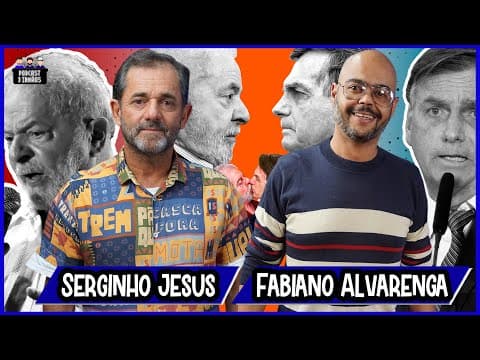
Serginho Jesus e Fabiano Alvarenga - Esquerda x Direita - Podcast 3 Irmãos #311
The Hypocrisy of Ideologies
The conversation delves into the perceived hypocrisy within both left-wing and evangelical circles. Serginho Jesus suggests that evangelical hypocrisy can lead one to 'hell,' while political ideology does not carry the same eternal consequence. Fabiano Alvarenga counters that while political hypocrisy exists, the theological hypocrisy within evangelicalism is more damning, especially when it's used to justify corruption or personal gain, as seen in some politicians who claim faith but act unethically.
Reincarnation and Spiritual Evolution
Fabiano Alvarenga discusses the concept of reincarnation and spiritual evolution, suggesting that individuals repeatedly return to Earth to learn and improve, striving to become more like Jesus. He posits that the afterlife is not a simple heaven or hell but a process of purgatory and progression, citing figures like Chico Xavier and Mother Teresa as examples of those who have spiritually evolved. This perspective emphasizes personal growth and the continuous journey of the soul.
Comparing Political Figures to Jesus
The conversation critically examines the tendency of some political figures, specifically mentioning Lula and Bolsonaro, to be compared to Jesus by their supporters or even by themselves. Fabiano Alvarenga dismisses such comparisons as irrational, highlighting Lula's biblical reference (Genesis 50:20) to frame his political actions and Bolsonaro's supporters calling him Jesus. He argues that true followers of Christ should focus on ethical behavior and compassion, particularly towards those within their own homes, rather than seeking divine comparisons.
Fabiano Alvarenga: The Flaws in 'Minha Casa, Minha Vida'
Fabiano Alvarenga criticizes government housing programs like 'Minha Casa, Minha Vida,' arguing that they create dependency and disincentivize self-sufficiency. He recounts an anecdote where recipients of housing assistance chose to return to favelas rather than pay for utilities or taxes, suggesting a preference for government handouts over responsible citizenship. He posits that people don't want to be productive citizens but rather rely on state aid.
Fabiano Alvarenga: The Perils of 'Printing Money'
Fabiano Alvarenga strongly criticizes the idea of 'printing money' as an economic solution, likening it to a 'money factory' that leads to inflation and economic instability. He references historical instances like the Collor government's economic measures and the concept of currency circulation, arguing that uncontrolled money emission erodes purchasing power and destabilizes the economy. He suggests that responsible economic management requires a clear understanding of currency circulation, not arbitrary emission to cover deficits.
Serginho Jesus: The 'Foro de São Paulo' and Latin American Socialism
Serginho Jesus expresses deep concern over the 'Foro de São Paulo,' which he describes as a 'criminal organization' allegedly led by Lula, Dirceu, and Fidel Castro, aiming to spread socialism across Latin America. He points to Venezuela, Nicaragua, Colombia, and Argentina as examples of countries that have allegedly fallen under socialist influence through this organization, suggesting a coordinated effort to undermine democracy and establish socialist regimes.
Serginho Jesus: The 'Centrão' as the Real Power Broker
Serginho Jesus posits that the 'Centrão,' a bloc of parties known for transactional politics, holds the true power in Brazil, regardless of who is president. He argues that any president, including Lula, must appease this bloc to govern effectively, suggesting that the real political maneuvering happens behind closed doors, not in public discourse.
Serginho Jesus: The 'Antichrist' as a Political Metaphor
Serginho Jesus uses the metaphor of the 'Antichrist' to describe the perceived spiritual and political corruption within certain segments of Brazilian society, particularly linking it to fundamentalist evangelical groups. He suggests this 'spirit' influences actions and divisions, creating a sense of impending conflict.
Fabiano Alvarenga: Lula's 'Revenge' Against the System
Fabiano Alvarenga suggests that Lula's return to power is driven by a desire for 'revenge' against the system that imprisoned him. He cites Lula's own statements about Brazil owing him, indicating a personal vendetta that could influence his governance and potentially lead to a more confrontational approach to the judiciary and political opponents.
Serginho Jesus: The 'Lesser Evil' Election Dilemma
The recent elections presented voters with a choice between two undesirable candidates, forcing them to select the 'lesser evil' rather than a preferred option. This situation highlights a systemic issue where the available political choices are perceived as fundamentally flawed, leading to a strategic, rather than enthusiastic, electoral outcome.
Fabiano Alvarenga: Bolsonaro's Pandemic Response Under Scrutiny
Fabiano Alvarenga argues that Bolsonaro's handling of the pandemic, particularly his downplaying of the virus as a 'gripezinha,' was a critical misstep that contributed to the high death toll. He contrasts this with Drauzio Varela's initial statements, suggesting that Bolsonaro amplified the dismissive narrative, leading to disastrous public health consequences.
Fabiano Alvarenga: The Myth of Disarmament Preventing Dictatorship
Fabiano Alvarenga challenges the notion that widespread gun ownership prevents dictatorship, citing the Middle East as an example where armed populations coexist with authoritarian regimes. He argues that historical dictatorships often begin with disarmament, suggesting that the debate over gun control is more complex than often portrayed.
Fabiano Alvarenga: Bolsonaro's Leadership Style
Fabiano Alvarenga critiques Bolsonaro's leadership, suggesting he lacked intellectual capacity and relied on ministers like Paulo Guedes for economic policy. He notes Bolsonaro's tendency to credit his ministers for achievements, which he believes helped elect them, contrasting this with Ciro Gomes's broader intellectual engagement.
Fabiano Alvarenga: Political Prisoners and Government Effectiveness
Fabiano Alvarenga points out that many ministers from the Bolsonaro government, along with Lula, were later imprisoned. He questions the effectiveness of Bolsonaro's government, citing issues like frequent changes in the health minister, suggesting a lack of consistent success.
Fabiano Alvarenga: The COAF Controversy and Moro's Departure
Fabiano Alvarenga discusses Bolsonaro's decision to move the COAF (Financial Activities Control Council) and Sérgio Moro's subsequent resignation. He suggests Moro's departure might be linked to interference or disagreements, hinting at potential political maneuvering behind these events.
Serginho Jesus: Political Ambitions and Machiavellianism
Serginho Jesus expresses his intention to enter politics soon, starting as a councilman. He references Machiavelli's 'The Prince,' noting its controversial 'ends justify the means' philosophy, and suggests this pragmatic, albeit 'macabre,' approach is necessary to achieve political objectives.
Serginho Jesus: Corruption in Brazilian Politics
Serginho Jesus acknowledges the deep-rooted corruption in Brazilian politics, suggesting that avoiding 'games' or corrupt practices can lead to political exclusion. He implies that entering politics often requires engaging in questionable dealings to survive.
Serginho Jesus: Campaign Finance and 'Rachadinha'
Serginho Jesus discusses campaign finance, specifically mentioning a 'rachadinha' (a scheme where public funds for staff are shared) and how funds are allocated for advisory roles. He questions the legality and ethics of these practices, suggesting they are common ways to fund campaigns.
Fabiano Alvarenga: The Fund Partidário Dilemma
Fabiano Alvarenga explains the 'fundo partidário' (party fund) distribution, noting that even if a candidate votes against it, they can still use the funds. He argues this is a pragmatic necessity to compete equally, despite the apparent hypocrisy.
Serginho Jesus: Campaign Funding Strategies
Serginho Jesus contrasts his own campaign strategy, which he estimates costs around R$2,000 for basic materials, with the larger sums allocated for advisory roles. He questions why campaigns take so long when the core work could be done quickly, suggesting a focus on efficiency over prolonged campaigning.
Fabiano Alvarenga: Party Fund Allocation Strategy
Fabiano Alvarenga explains that party funds are allocated based on strategic priorities, favoring states where a party has a better chance of electing candidates. This means candidates in less competitive regions might receive less funding, even if they are long-serving.
Serginho Jesus: The Focus on 'Moral Pauta'
Serginho Jesus observes that Brazilian politics has shifted towards 'moral pauta' (moral issues) over substantive policy areas like health, education, and economy. He suggests this focus on social issues is a strategic choice by politicians to engage voters.
Fabiano Alvarenga: The Illusion of Local Representation
Fabiano Alvarenga contends that electing a deputy solely for local benefits is a flawed strategy, as these representatives often vote based on party lines or national interests, rendering local promises ineffective. He implies that true change requires a broader national vision, not just local concessions.
Fabiano Alvarenga: Voter Discontent and Local Representation
Fabiano Alvarenga suggests that voters in Araguari might have supported local candidates like Raul and Zé Vitor because they felt neglected by the system, seeking representatives who promised to address their immediate needs, such as better public services.
Serginho Jesus: The Secret Ballot and Accountability
Serginho Jesus criticizes the secret ballot system in Congress, arguing it prevents voters from knowing how their representatives voted. He calls this a 'filha da putagem' (son of a bitch move), implying it shields politicians from accountability.
Serginho Jesus: Election Fraud Allegations and TSE's Stance
Serginho Jesus expresses certainty about election fraud, citing irregularities like more votes than voters in Uberaba. He criticizes the TSE president, Alexandre de Moraes, for stating that fraud investigation is the parties' responsibility, not the court's.
Fabiano Alvarenga: The Impact of Radio Insertions vs. Police Actions
Fabiano Alvarenga questions the relative impact of alleged radio insertion disparities favoring Lula versus police actions hindering Bolsonaro voters. He implies that physical impediments to voting might be more significant than biased media coverage.
Fabiano Alvarenga: The Army's Inaction and Lula's Assumption of Power
Fabiano Alvarenga expresses pessimism about the army intervening, believing Lula will assume the presidency despite potential negative consequences for Brazil. He suggests that 'good people' who believe in election integrity are left powerless.
Serginho Jesus: The Enduring Nature of Fake News
Fake news and disinformation tactics are not new phenomena; they have existed throughout history, evolving from pamphlets and letters to digital formats. The core intent to manipulate public opinion remains constant, regardless of the medium.
Fabiano Alvarenga: Bolsonaro's 2018 Election and PT's Role
Bolsonaro's rise to power in 2018 was largely facilitated by the perceived corruption and missteps of the PT (Workers' Party), suggesting that his election was more a consequence of opposition fatigue than inherent popularity.
Serginho Jesus: The 'Centrão' and Political Corruption
The 'Centrão' political bloc, historically involved in budget allocation and potentially corrupt practices, continues to exert influence, suggesting a cyclical nature of corruption in Brazilian politics where new names or structures emerge but the underlying issues persist.
Serginho Jesus: Economic Strategy and Social Programs
While Lula's government may implement social programs like 'Auxílio Brasil', the funding for these initiatives ultimately comes from the nation's revenue, which is influenced by economic performance and potentially from taxing profitable companies. The idea of 'free lunch' is a fallacy; economic strategies must be sustainable.
Serginho Jesus: The Unpredictability of Economic Performance
Brazil's economic performance, even during challenging global times, has been relatively strong compared to many developed nations. However, this success is attributed to factors beyond specific presidential policies, and future outcomes remain uncertain due to potential global interventions or domestic strategies.
Fabiano Alvarenga: The Illusion of Presidential Power
The true power in Brazil lies not with the president's personality or speeches, but with economists and financial entities who dictate policy. Presidents, regardless of their charisma or ideology, are often beholden to these systems, which ultimately 'bleed' the country's economy.
Fabiano Alvarenga: Navigating Party Affiliation
Fabiano Alvarenga discusses the challenges of party affiliation, noting that traditional parties can be stifling. He expresses interest in joining a party like Novo, despite having criticisms, because it aligns more with his ideas. He emphasizes the need for an 'electoral CNPJ' (legal entity) to run for office, suggesting that party membership is often a means to an end.
Fabiano Alvarenga: Political Compromise and Personal Faith
Fabiano Alvarenga contrasts his political journey with that of religious figures entering politics. He states he is a politician who encountered Jesus, not an evangelical who entered politics, implying a different foundation for his actions. He criticizes religious leaders for prioritizing politics over their spiritual mission, suggesting a loss of focus on caring for souls.
Fabiano Alvarenga: The Ideal of Ficha Limpa in Politics
Fabiano Alvarenga addresses a listener's question about requiring political candidates to have a 'ficha limpa' (clean record) and undergo social investigation. He argues that such a requirement might be unconstitutional, as party ideology should not restrict entry. He contrasts this with the Novo party's stricter entry requirements, questioning why other parties cannot adopt similar standards.
Fabiano Alvarenga: The 'Elephant Poop' Analogy and Political Corruption
Fabiano Alvarenga uses a provocative analogy comparing the sons of Lula and Bolsonaro to illustrate accusations of corruption. He likens Lula's son's wealth to cleaning elephant poop at a zoo, while Bolsonaro's sons' wealth is framed as cleaning it with a cotton swab, implying a scale of illicit gain. He criticizes the deflection tactics used in political discourse, where accusations against one side are met with counter-accusations about the other.
Serginho Jesus: The Ratinho Phenomenon and Media Influence
Serginho Jesus discusses the media personality Ratinho (Carlos Massa), noting his transition from a circus performer to a successful politician and media mogul. He recounts Ratinho's brief stint as a federal deputy and his subsequent focus on his media empire, suggesting that Ratinho's success, particularly his fortune, is tied to significant capital and strategic positioning, possibly linked to figures like Carlos Massa.
Fabiano Alvarenga: Araguari's Questionable Public Spending
In Araguari, the mayor's office has allegedly rented an expensive property near the bus station for its operations, despite having an abandoned, usable building nearby that could have been renovated. This suggests a potential misuse of public funds, prioritizing costly rentals over efficient use of existing infrastructure.
Robertinho: The Allure and Danger of Corruption
Robertinho articulates a deep-seated fear of corruption, acknowledging that 'every man has his price' and that even well-intentioned individuals can be tempted by financial incentives, as illustrated by his anecdote about a general attempting to bribe a president. He vows to be a councilman who only fiscalizes and avoids making laws, recognizing the pervasive nature of corruption.