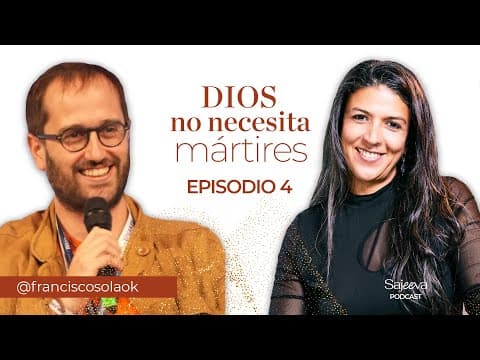
Original sin is not about eating an apple, but the belief in being separate from God. This separation is an illusion, and true healing comes from remembering our inherent oneness with the divine, as taught by 'A Course in Miracles.' The concept of healing is not returning to God, but realizing we never left.
The Power of Vulnerable Connection
The initial meeting between the host and Francisco Sola in a Mexican bar was a profound moment of vulnerability and connection, remembered as superior to later interactions due to its raw intimacy. This shared vulnerability allowed them to see each other with 'the eyes of the heart,' fostering a deep friendship.
Demystifying 'A Course in Miracles'
'A Course in Miracles' is a channeled text aiming to reprogram the mind through Christian symbolism, teaching non-dualistic metaphysics. It's a healing tool that helps correct the 'wound of separation' by changing perception, leading to stress reduction and positive outcomes in health, relationships, and abundance.
God as Unity, Not Separation
Unlike theistic religions that posit a separate creator, 'A Course in Miracles' suggests God and creation are one, with God extending into everything. This non-dualistic view, akin to Eastern traditions, posits that the perceived separation is a fleeting illusion, a dream from which we awaken to our eternal oneness.
Divine Support and Personal Responsibility
You can prevent God from entering your life, but you cannot prevent God from sustaining you. This means that even if you believe in evil or lack, it's a personal creation, and divine support remains constant. True freedom lies in choosing your 'yes' and 'no' from your core being, not from ego-driven narratives.
Healing Through Teaching and Letting Go of Defenses
The most profound healing occurs when we teach others, as learning happens through imparting knowledge. The greatest challenge in this process is the 'renunciation of defense,' letting go of the ego's need to be right, which is ultimately futile in the face of a divinely created reality.
Jesus' Crucifixion as Ego Death
The crucifixion is presented not as a sacrifice for sin, but as the ultimate act of the ego's attempt to prove Jesus' lack of divinity. Jesus' surrender, saying 'Father, forgive them,' signifies his detachment from the physical world and the death of his ego, asserting that his true identity as the Son of God cannot be threatened.
Mary Magdalene: First Witness to Resurrection
Sola highlights that Mary Magdalene was the first person to see the resurrected Christ, a fact often overlooked. He suggests her story has been distorted, portraying her as a sinner when she was likely a woman full of life who recognized Jesus' continued presence within humanity, teaching the disciples that he had not truly died.
Atheism vs. Religion: A Personal Journey
Both speakers share personal journeys from religious upbringing to atheism, clarifying that their rejection is of organized religion, not of a divine presence or spiritual connection. Sola asserts his atheism stems from the certainty of his non-existence as a separate self, merging with God, while Krystal found her spiritual connection outside of religious structures.
Embracing the Shadow Self
Sola explains that the 'shadow' represents hidden aspects of oneself (e.g., sexuality, career desires) suppressed to fit societal norms. He argues that true power and healing come from blessing and integrating this shadow, rather than just focusing on the 'apostolic body' (the presented self), leading to wholeness and divine expression.
Sacralization Over Sacrifice
Sola distinguishes between 'sacralizing' and 'sacrificing,' explaining that sacralizing an action (like sexuality or career choice) makes it sacred, not a sacrifice. This act of blessing and integrating all aspects of life, including the shadow, reduces separation and the impulse towards harmful actions, which stem from repression and societal judgment.
Divine Guidance and Unexpected Journeys
Following the exorcism encounter, Sola felt guided to go to Italy, believing he was meant to meet his ex-partner. However, upon arrival and subsequent calls, he realized this was not the case. He then received a message from a child to go to Rome, where he met a man who prophesied Sola's immense power and the need to integrate his shadow self.
Sayiva: Reframing 'Demonic Possession'
Francisco Sola recounts an experience where a young woman's struggle with her sexuality in a hyper-conservative environment led to a 'psychosis with mystical delirium,' which was interpreted as demonic possession. Sola argues that this was a manifestation of her repressed masculine side desiring women, and that acceptance, not judgment, is the path to healing. The final sentence emphasizes that embracing one's true self without judgment is the ultimate act of self-love and liberation.
Sayiva & Francisco Sola: Embracing Authenticity
The conversation shifts to the importance of living authentically, with Sola advocating to 'obey only yourself and your beloved.' He connects this to loving another person as a sacred bond, emphasizing that following one's heart leads to miracles and healing. Sayiva agrees, highlighting Sola's embodiment of his teachings and his role as a master who 'preaches by example,' citing Pope Francis's message to 'do as I have done' (washing disciples' feet). The final sentence reinforces that embodying one's truth is the ultimate form of teaching and living.