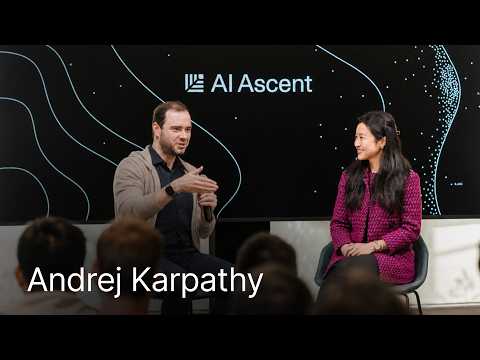
Andrej Karpathy: From Vibe Coding to Agentic Engineering
The Future of Computing and AI's Role
Extrapolating current trends, Karpathy envisions a future where neural networks become the primary computing substrate, potentially acting as host processes while CPUs function as co-processors. This could lead to radically different, 'foreign' computing architectures where AI performs the bulk of the heavy lifting, utilizing tools as secondary functions. He suggests that much of what we consider software development today might become obsolete, replaced by AI-driven information processing and generation, opening up entirely new possibilities that were previously impossible.
Agentic Engineering vs. Vibe Coding
Karpathy distinguishes 'vibe coding' as raising the general floor of software development capabilities for everyone, making basic coding tasks more accessible. In contrast, 'agentic engineering' focuses on preserving and enhancing the quality bar of professional software development by coordinating powerful AI agents. It's about using these agents to increase speed and capability (magnifying the '10x engineer' effect) without introducing vulnerabilities or sacrificing quality. This discipline involves managing the stochastic nature of agents to achieve high-quality, scalable outcomes, representing a more advanced and rigorous application of AI in development.
Karpathy: From Vibe Coding to Agentic Engineering
The evolution of AI development is moving beyond simple 'vibe coding' where engineers fill in API details, towards 'agentic engineering.' In this new paradigm, AI agents are empowered with real permissions, local context, and the ability to take actions on behalf of users, fundamentally changing how software and infrastructure are built and interacted with. The focus shifts from human-readable documentation to agent-native descriptions and data structures.
The 'Ghosts vs. Animals' Analogy for AI
Karpathy frames current AI models not as 'animals' with intrinsic motivations like curiosity or fun, but as 'ghosts' – jagged forms of intelligence shaped solely by data and reward functions. This distinction matters because it highlights that AI lacks genuine understanding or subjective experience, making it crucial for humans to retain control over directing AI's purpose and evaluating its outputs, as AI cannot 'outsource' its own understanding.
The Future of Agent-Native Infrastructure
The future of computing will be 'agent-native,' meaning systems and infrastructure will be designed primarily for AI agents to interact with, rather than humans. This involves decomposing workloads into sensors and actuators, and creating data structures that are highly legible to LLMs. The goal is to enable seamless agent-to-agent communication and task execution, reducing the need for human intervention in configuration and deployment, as exemplified by the challenges faced with deploying projects like Menuguen.
Understanding as the Human Bottleneck
Even as AI capabilities advance and thinking can be outsourced, the fundamental human capacity for 'understanding' remains a critical bottleneck. While AI can process information and generate outputs, it is the human who must direct this process, know what to build, and why it's worth doing. Tools like AI knowledge bases can enhance this understanding by providing new projections onto information, but the ultimate responsibility for comprehension and direction rests with the human.