How Forward Deployed Engineering 10X'd Revenue for HappyRobot (YC AI Startup)
Why Logistics Tech Historically Stalled
Freight brokerage and physical supply chains continue to operate through manual phone calls, emails, and legacy spreadsheets because previous generations of automation lacked conversational flexibility. Earlier machine learning approaches required fine-tuning narrow classifiers that could not generalize across messy communications. Pablo Palafox points out that modern large language models finally offer the versatile reasoning necessary to manage this complexity.
Demystifying AI to Manage Expectations
Pablo Palafox explains that communicating effectively with enterprise customers requires stripping away mystical marketing terms and explicitly showing the underlying prompting and error possibilities. Rather than pitching magic, teams must explain that language models simply predict text tokens and handle standard cases while human operators solve edge exceptions. Grounding customer expectations prevents premature disillusionment and builds lasting operational trust.
On-Site Deployment Beats Integration Friction
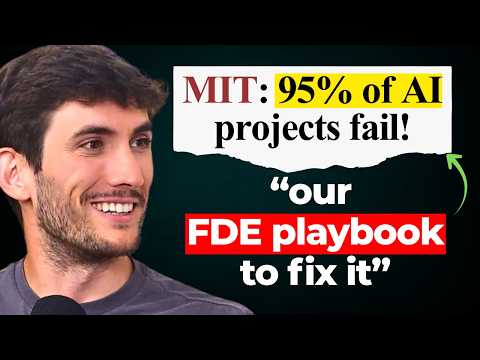
Addressing an MIT finding that 95 percent of enterprise AI deployments fail, Pablo Palafox attributes failures to change management, telephony friction, and bespoke database architectures. Happy Robot avoided this failure trap by placing engineers directly on site to build and calibrate integrations in real time. This hands-on presence ensures that technical and human hurdles are resolved before a rollout derails.
Mid-Market Failures Teach Radical Ownership
Pablo Palafox openly admits that the company stumbled on several mid-market deployments when client companies lacked a dedicated internal lead to coordinate integration. Without proactive client-side ownership, communication slipped through the cracks until the startup learned to enforce clear internal champions and daily status checks. These early mistakes established extreme accountability as a non-negotiable operational standard.
Surmounting Telephony and Human Friction
Deploying voice agents across legacy freight brokerages introduces roadblocks ranging from defensive telephony providers to employee fears of job displacement. In one case, a client team initially listed the startup as a corporate threat before eventually embracing the software as an indispensable operational partner. Navigating both the technical protocols and the human psychology of automation remains essential to enterprise expansion.
Structuring Enterprise Pilots for Momentum
Pablo Palafox observes that requiring upfront pilot fees often slows enterprise momentum down by triggering tedious procurement cycles without improving conversion rates. Offering a clean trial window with clear completion metrics and an embedded cancellation option speeds adoption while building buyer confidence. Setting rigid evaluation deadlines keeps both sides aligned on concrete business outcomes.
Transitioning Services into Autonomous Products
While forward deployed engineers are necessary to initiate enterprise workflows today, their ultimate objective is to automate their own deployment tasks through meta-prompting and self-serve tooling. By mapping entity ontologies across carriers, drivers, and loads, engineers elevate their focus from low-level API wiring to strategic operational design. The long-term business model evolves from bespoke services into an autonomous operating platform.