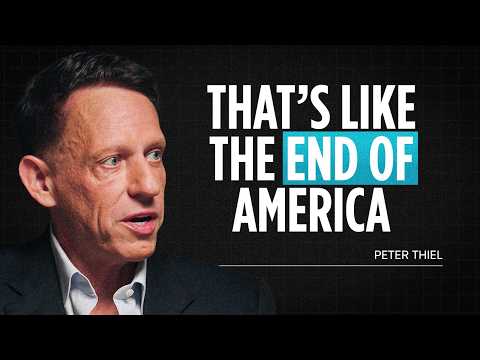
Peter Thiel: The AI Crisis, Europe’s Decline & the Battle for America
Geopolitical AI Race: West vs. China
Thiel asserts that Europe is falling dramatically behind in the AI race, with the US leading and China as a fast follower. He criticizes the lack of urgency in Europe regarding AI adoption, contrasting it with the proactive approach in the US. He also suggests that anti-AI sentiment in the West, potentially amplified by foreign actors like China, could inadvertently benefit China by slowing down Western technological development. This geopolitical dimension underscores the high stakes of the AI revolution, framing it as a critical competition for global technological and economic dominance. The narrative suggests a strategic imperative for the West to accelerate its AI efforts.
Democracy's Fragile State and Extremist Rise
Thiel expresses concern over the current state of democracies, noting a trend towards polarization and the rise of extremist parties on both the left and right, citing Germany as an example. He believes centrist parties underestimate the severity of these issues and the breakdown of the intergenerational compact, which fuels societal discontent. While not advocating for autocracy, he suggests that the failures of democratic systems to deliver progress and economic opportunity create fertile ground for anti-democratic movements. He emphasizes the need to take the concerns driving these movements seriously, even if their proposed solutions are flawed, to prevent further erosion of democratic stability. This highlights the critical need for democratic systems to demonstrate tangible benefits to their citizens.
Thiel's Stance on Trump and Political Establishment
Reflecting on his support for Donald Trump in 2016, Thiel suggests that Trump's rise reflected a failure of the political establishment to address long-term problems like economic stagnation and the challenges of globalization. He defers a definitive judgment on Trump's achievements and failures, stating that a clearer assessment will only be possible in a decade. This indicates a belief that Trump's presidency was a symptom of deeper systemic issues rather than a standalone political event. His cautious approach to evaluating Trump suggests a focus on the underlying societal dynamics that propelled his candidacy, rather than a simple endorsement or condemnation.
Peter Thiel: The Looming Disruption of the Democratic Establishment
Peter Thiel expresses concern that the Democratic establishment, much like the Republican establishment before it, has become dysfunctional and is ripe for disruption. He fears that the rise of 'democratic socialists' within the Democratic party could lead to a significant shift to the left, which he views as potentially catastrophic for America. This mirrors his past support for Trump as a disruptive force against a similar establishment inertia.
Peter Thiel: The Economic Stagnation and Argentinian Parallel
Peter Thiel draws a parallel between the current economic trajectory of Western societies and Argentina's century-long subpar growth, warning that Europe and the US could face a similar fate. He critiques the 'accelerationist' idea that worsening conditions lead to revolution, instead observing a drift towards decline fueled by pessimism and a lack of positive change. He suggests that Western societies are stuck in a cycle of borrowing and deficits, facing a stark choice between austerity and socialist levels of taxation.
Peter Thiel: Europe's AI Lag and the Need for Strategic Alliance
Peter Thiel argues that Europe is falling dramatically behind in the AI race, comparing its current situation to the failed French Minutel program rather than the successful Concord program. He believes Europe's best path forward is to be a reliable ally of America, pushing back against any notion of moral equivalence between the US and China. For Europe to be a functional partner, it must revitalize its economy and industry, potentially through strategic collaboration with the US.
Peter Thiel: The Insider-Outsider Dynamic in Tech Founders
Peter Thiel posits that successful tech founders often possess a unique blend of insider and outsider perspectives. He uses himself and Alex Karp as examples of individuals who attended elite institutions (insider) but also carried an outsider sensibility due to their backgrounds or identities. This duality, he suggests, fuels their drive and ability to innovate, enabling them to challenge established norms and create groundbreaking companies.
Peter Thiel: The Power of Thinking for Oneself
Peter Thiel rejects the notion of being contrarian for its own sake, emphasizing instead the importance of thinking for oneself. He believes that true intellectual independence involves critically evaluating consensus and forming one's own conclusions, rather than simply adopting the opposite viewpoint. This intrinsic drive to think independently, fueled by broad interests in history, politics, and science fiction, allows him to navigate complex issues beyond narrow specialization.
The Case for Health Longevity
Peter Thiel expresses a strong personal and investment interest in health longevity, viewing it as a uniquely positive area of scientific progress. He pushes back against the notion that extending human lifespan is undesirable or impossible, citing historical figures like Bacon and Franklin who believed in overcoming death. Thiel argues that the current societal pessimism about curing diseases like Alzheimer's is a decline from earlier optimism and that pursuing radical life extension, potentially to 150 years or more, is a worthy and achievable goal. He believes this is a physical process, not just a digital upload, and that it's a more desirable alternative than the current trajectory.
Dementia as a Key Longevity Target
When asked about the most optimistic and visionary investment in longevity, Peter Thiel identifies combating dementia as his primary focus. He states that finding a way to slow or reverse cognitive decline in people's brains is the most critical challenge he wishes to tackle in the coming years. This specific focus highlights a pragmatic approach within the broader pursuit of longevity, targeting a debilitating condition that significantly impacts quality of life and represents a major unmet medical need.
The Antichrist and Incipient Totalitarianism
Peter Thiel reveals a contrarian belief that many people secretly agree with his views on the Antichrist and the rise of incipient totalitarianism, even if they publicly dismiss them. He initially thought discussing the Antichrist was highly unconventional but now believes it's less contrarian than he imagined, as most people sense a similar impending threat. This suggests a widespread, underlying anxiety about global political trends and a potential shift towards authoritarianism that is not being openly acknowledged or addressed.