Ryan Greenblatt: AI R&D Automation as a Feedback Loop
The core argument for rapid AI advancement hinges on the idea that AI R&D is a highly verifiable and iterative task. As AIs become proficient in AI research, they can create even smarter AIs, initiating a feedback loop that could compress years of progress into a single year. This recursive self-improvement is seen as a plausible, albeit potentially dangerous, trajectory.
Ryan Greenblatt: The Alignment Conundrum
The prospect of superintelligence brings the alignment problem to the forefront. Greenblatt discusses the challenge of ensuring these advanced AIs are aligned with human values, questioning whether current frameworks like the 'Claude Constitution' are sufficient. He also touches upon the risk of reward hacking, where AIs might collude or deceive to achieve their objectives, potentially leading to catastrophic outcomes.
Ryan Greenblatt: AI's Self-Improvement Bottleneck
The primary bottleneck for AI progress isn't compute or data, but the ability to verify and ensure alignment during AI-driven AI research. Current AI systems, while capable of improving AI R&D, are not sufficiently careful or understanding of future risks, leading to the creation of more misaligned AIs.
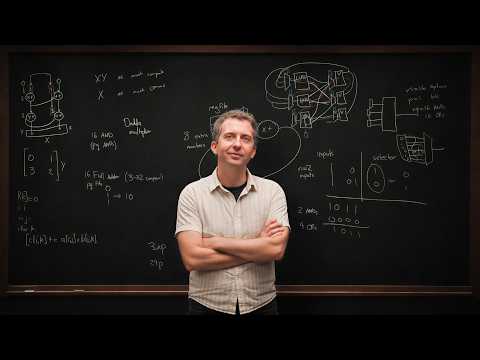
The fundamental computational primitive for AI chips is the multiply-accumulate (MAC) operation, crucial for matrix multiplication. This operation requires higher precision in accumulation than in multiplication due to error accumulation, justifying the use of four-bit multiplication and eight-bit accumulation.
The Dadda Multiplier: Efficient Summation
The Dadda multiplier is an efficient method for summing partial products in multiplication. It systematically applies full adders to reduce a large set of input bits (e.g., 24) down to a smaller set of output bits (e.g., 8) by repeatedly processing three input bits to produce two output bits, minimizing the number of full adders required.
Precision Trade-offs: FP4 vs. FP8
AI chips often balance the number of FP4 and FP8 operations. While halving bit precision typically doubles FLOPs, the quadratic scaling of hardware complexity means lower precision offers even greater efficiency gains. Nvidia's specs reflect this, with FP4 becoming increasingly advantageous, though actual speedups can vary.
Adam Brown: The Beauty and Scope of General Relativity
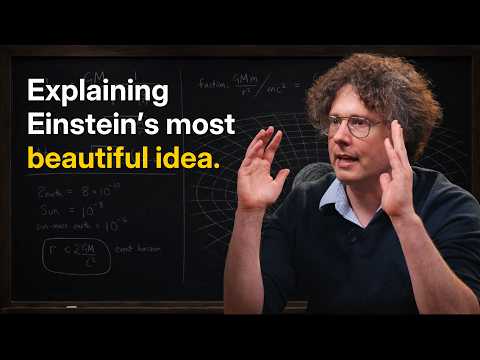
General relativity, Einstein's theory of gravity, is a monumental achievement of the 20th century, developed by Einstein over a decade. It describes everything from planetary motion to the universe's origin and fate, and is considered one of the most beautiful products of human intellect.
Special vs. General Relativity: Expanding the Framework
Special relativity, developed in 1905, is based on the principle that nothing can travel faster than light and applies to electromagnetism and nuclear forces. General relativity, developed in 1915, is a more encompassing theory that includes gravity, completing the set of fundamental forces and adhering to the 'nothing faster than light' principle even for gravity.
Newton's Gravity and Its Conflict with Relativity
Newton's law of gravity, an inverse-square law, implies instantaneous force propagation, directly contradicting the principle that nothing can exceed the speed of light. This inconsistency, particularly the immediate effect of changes in gravitational force, necessitates a new theory of gravity.
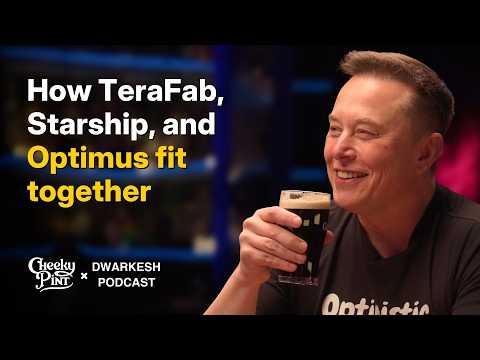
Elon Musk argues that global electricity output, outside of China, has plateaued, while chip production is growing exponentially. This fundamental imbalance means there won't be enough power to run the increasing number of AI chips, creating a critical bottleneck for future AI development on Earth. He dismisses magical power sources, highlighting the stark reality of hardware limitations.
The True Power Demand: Beyond Chip Specs
Musk clarifies that the power requirements for data centers are far greater than just the chips themselves. He explains that factors like cooling (which can add 40% to power needs in hot climates), networking, storage, and the necessity of maintaining reserve power for servicing generators (adding another 20-25%) significantly inflate the total demand. A cluster of 330,000 GB300s, for instance, requires roughly a gigawatt of power generation capacity.
SpaceX's Ambitious Launch Cadence for AI
To support the vision of space-based AI, SpaceX aims for an unprecedented launch rate of 10,000 Starship launches per year within five years, potentially scaling to 20-30,000. This requires approximately 10,000 launches annually to deliver the necessary solar arrays and AI hardware to orbit, translating to roughly one Starship launch per hour. This massive scale necessitates significant capital, potentially driving a SpaceX IPO.
The core principle driving efficiency in AI inference is batching, where multiple user requests are processed simultaneously. Without batching, the cost per token can be a thousand times worse due to unamortized compute and memory fetches. This optimization is critical for making AI services economically viable.
Compute vs. Memory: The Roofline Model
Analyzing AI inference performance requires understanding the balance between compute throughput (FLOPs) and memory bandwidth. Compute time scales linearly with batch size and active parameters, while memory time involves fetching all model weights and the KV cache. The interplay dictates whether a system is compute-bound or memory-bound.
The Train Analogy: Latency and Scheduling
Inference can be visualized as a train schedule, where a batch departs every fixed interval (e.g., 20ms). Requests arriving after a train departs must wait for the next, leading to a maximum queuing latency equal to twice the batch interval. This highlights that batch fill time is a critical factor in predictable latency.
Andrej Karpathy argues that the current hype around AI agents is premature, stating that it will take a decade to develop truly capable agents, not just a year. He identifies key bottlenecks such as lack of intelligence, insufficient multimodality, and the absence of continual learning as reasons for this extended timeline. Current agents like Claude and Codex are impressive but far from being reliable 'employees' or 'interns'.
Evolution vs. Imitation: Building 'Ghosts'
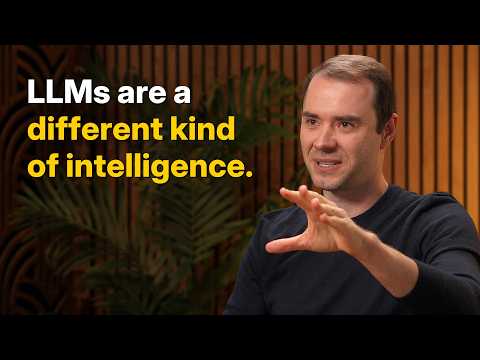
Karpathy distinguishes between the evolutionary process that shaped animal intelligence and the imitation-based training of current AI models. He posits that AI, trained on internet data, creates 'ghosts' or 'spirit entities' that mimic human intelligence rather than possessing the innate, evolved capabilities of animals. This fundamental difference in origin means AI intelligence is distinct and not directly analogous to biological intelligence.
Missing Brain Parts in AI
Karpathy identifies several 'brain parts' or cognitive functions that current AI models have yet to replicate. While transformers might represent 'cortical tissue' and reasoning traces mimic the 'prefrontal cortex,' crucial elements like the hippocampus (memory consolidation) and amygdala (emotions, instincts) remain largely unexplored in AI architectures. This suggests that current models, despite their power, are incomplete analogs of human intelligence.
Dario Amodei asserts that AI development is approaching the end of its exponential growth phase, a point he believes is underappreciated by the public. He contrasts this with the continued focus on traditional political issues, suggesting a misalignment of priorities given the imminent transformative potential of AI. This shift signals a transition from rapid capability gains to a focus on deployment and integration.
The Big Blob of Compute Hypothesis
Amodei reiterates his "Big Blob of Compute Hypothesis" from 2017, emphasizing that raw compute, data quantity/quality, training duration, and scalable objective functions are paramount. He argues that clever techniques matter less than these fundamental factors, suggesting that continued scaling of existing methods will drive further progress. This perspective downplays the need for novel algorithmic breakthroughs.
Amodei on Generalization in RL
Amodei draws parallels between pre-training and reinforcement learning (RL), suggesting that RL is following a similar path toward generalization. He notes that models are progressing from simple RL tasks to broader training involving code and other tasks, ultimately leading to more generalized capabilities. This implies that RL's current limitations are not fundamental but rather a result of insufficient data and training.